RH
Search Result
Firm
user
SellSmartR
·
5 months ago
0
0
When Nvidia Rises 4%, This AI Big Tech Gains 8%?

Neutral
Neutral
BABA
Alibaba Group Holding ADR Representing 8
user
SellSmartR
·
5 months ago
0
0
When Nvidia Rises 4%, This AI Big Tech Gains 8%?
Yesterday (15th), the S&P 500 and Dow Jones declined, but the Nasdaq reached a record high. The gain was largely driven by Nvidia, which rose 4% after the U.S. government approved resumed chip sales to China, boosting the broader tech sector. Interestingly, as Nvidia gained 4%, one Big Tech company jumped even higher—8%.One-Week Snapshot: China's AI GiantsAlibaba ADR (BABA) rose approximately 8.1% yesterday (15th). It wasn't alone—other U.S.-listed Chinese tech giants, including Tencent (TCEHY) and Baidu (BIDU), joined the surge. The common denominator? AI. At SellSmart, we're focused specifically on Alibaba. Why Alibaba? Globally recognized for e-commerce platforms like Taobao and AliExpress, Alibaba’s primary growth drivers—often overlooked by investors—are AI and cloud computing. Alibaba recently announced plans to invest approximately 380 billion yuan (around $53 billion) into cloud and AI infrastructure over the next three years, strategically expanding beyond e-commerce into logistics and fintech. In March, Alibaba released its open-source chatbot "QwQ-32B," followed in June by "Qwen VLo," a multimodal AI model enabling image generation—clear signals of aggressive moves into AI innovation.Year-to-Date Returns for China’s Big Tech AI TrioThe standout from Alibaba's Q1 2025 earnings was its rapidly growing Cloud Intelligence segment. Revenue jumped 18% year-over-year to 30.13 billion yuan, surpassing market expectations (29.9 billion yuan). Most notably, AI-driven revenue maintained triple-digit growth for the seventh consecutive quarter, underscoring Alibaba’s accelerating competitiveness in AI infrastructure and solutions. While overall revenue slightly missed forecasts—totaling 236.45 billion yuan versus 239.7 billion expected—adjusted EBITA came in strong at 32.62 billion yuan, exceeding market consensus (31.85 billion yuan). Momentum: Expanding AI ecosystem through collaboration with AppleApple needs AI capabilities to remain competitive in China but can only integrate AI approved by Chinese regulators into its "Apple Intelligence" ecosystem. On June 16, just four months after announcing their partnership, Alibaba released its Qwen-3 model optimized for Apple’s MLX machine learning framework. This positions Alibaba’s Qwen-3 to expand its AI footprint across China’s entire Apple ecosystem—including iPhones, iPads, and MacBooks. What is Qwen-3?Qwen-3, announced on April 29 this year, is Alibaba’s latest large language model (LLM).Its largest variant, Qwen-3-235B, outperformed models such as OpenAI’s o1, o3-mini-medium, DeepSeek R1, and Grok 3-Thinking in benchmark tests.The smaller Qwen-3 30B-A3B model demonstrated benchmark performance surpassing Gemma3, Deepseek-v3, and GPT-4o.Trained on roughly 36 trillion tokens and supporting 119 languages, Qwen-3 leverages a hybrid thinking mode—carefully processing complex tasks for greater accuracy, and rapidly responding to simpler queries, significantly boosting efficiency. Expanding Cloud InfrastructureChina's cloud infrastructure services are dominated by Alibaba, Huawei, and Tencent, holding market shares of 33%, 18%, and 10%, respectively. Alibaba’s cloud-related revenues grew by 15% year-over-year, while Tencent faced stagnation due to GPU supply constraints and internal prioritization of AI chips. Alibaba is expanding its regional infrastructure, opening its third data center in Malaysia in early July, with plans to launch a second data center in the Philippines by October—addressing growing AI demand across Southeast Asia. Wrapping UpThe resumed exports of Nvidia’s H20 chips to China present a pivotal momentum boost for Alibaba, which is strategically centering its growth around AI and cloud infrastructure. With Qwen-3 now integrated into Apple's ecosystem, Alibaba is positioned to gain significant ground in China's AI leadership race. In an environment marked by technological regulation and geopolitical tension, Alibaba’s dual focus on strong financial results and global partnerships makes it a company to watch closely.[Compliance Note]All posts by Sellsmart are for informational purposes only. Final investment decisions should be made with careful judgment and at the investor’s own risk.The content of this post may be inaccurate, and any profits or losses resulting from trades are solely the responsibility of the investor.Core16 may hold positions in the stocks mentioned in this post and may buy or sell them at any time.
article
Neutral
Neutral
BABA
Alibaba Group Holding ADR Representing 8
user
셀스마트 판다
·
5 months ago
0
0
K-Demon Hunters Goes Global — The Surprise Beneficiary? Nongshim

There is a song trending on Spotify right nowThe OST tracks “Your Idol” and “Golden” from K-pop Demon Hunters are gaining serious attention.These songs ranked number 1 and 2 on Spotify’s US Daily Top Songs chartGolden entered the Billboard Hot 100 at number 23and the soundtrack album reached number 3 on the Billboard 200With this much buzz around the OST, it is natural for attention to turn to entertainment stocksBut the stock we are highlighting today is not HYBE or YGIt is the unexpected beneficiary—Nongshim HoldingsA global sensation that started with zero expectationsK-pop Demon Hunters, or KDHH, is an original animation produced by Sony Pictures. It follows the story of Huntress, a K-pop girl group trio—Lumi, Mira, and Joy—who moonlight as demon hunters behind the stage.Expectations were low before its release. In fact, close to zero.The premise—a Korean idol group created by a Japanese studio under American financing—reminded many of past Western attempts to mash up East Asian culture, often ending in failure.But once the film was released, the response was overwhelming.·        Charming character designs inspired by jakhodo art·        Detailed depictions of Korean food culture like ramen, gimbap, and hotteok·        An OST that captured the full spirit of K-pop·        Small cultural touches, like using tissue paper as a chopstick rest at restaurantsEven the subtlest details, instantly recognizable to Korean viewers, were faithfully portrayed.The result? Global fans praised it as “authentically Korean.”And the numbers followed:·        Ranked No. 1 globally in Netflix’s film category during its first week·        Hit No. 1 in 41 countries, including the US, Germany, and Thailand·        Dance moves from the film’s fictional idol group became real K-pop dance challengesThis led to a second wave of content spreading across platforms.Netflix and Sony were caught off guard by the success and scrambled to produce official merchandiseMeanwhile, a jakhodo-inspired badge from the National Museum of Korea sold out as an unofficial “fan good.”Nongshim Keeps Popping Up in K-Demon HuntersAs you watch the film, certain elements start to stand out.The spicy chips that lead character Joy eats look strikingly similar to Shrimp Crackers.The cup ramen eaten by Huntress members is branded “Dongshim” and features a large red character “Shin,” clearly reminiscent of Shin Ramyun. Even the instructions—“pour hot water and wait three minutes”—match the real product.Ahead of the film’s release, Netflix held a promotional event in New York City, handing out instant ramen to passersby.What makes this even more interesting is that Nongshim had no official PPL or sponsorship deal with K-pop Demon Hunters.The film’s global success has unintentionally delivered Nongshim a wave of free international exposure.K-Content? The Formula That Drives Real-World SalesThere have been past cases where K-content led directly to consumer spending.The 2020 Oscar-winning film Parasite is a prime example of K-content driving global consumption.The appearance of “Chapaguri” in the film caught international audiences by surprise. In the month following the film’s release, Nongshim’s overseas sales of Chapagetti more than doubled year over year, reaching approximately 1.5 million dollars.In March, BLACKPINK’s Jennie mentioned Banana Kick and Shrimp Crackers as her favorite snacks on The Jennifer Hudson Show. Just four days later, Nongshim’s market cap jumped by 260 billion KRW—an example of the “five-second magic” effect in action.This isn’t new. K-content has repeatedly influenced real consumer behavior abroad, translating into tangible gains in both revenue and stock price.K-pop Demon Hunters also features recurring elements that closely resemble Nongshim products, suggesting a similar ripple effect in global consumer markets may follow.Nongshim vs. Nongshim Holdings — Why the Real Play Is the Holding Company(This is Nongshim’s Instagram post from today, the 11th. Could it be hinting at a K-Demon Hunters collaboration?)Then why not just buy Nongshim directly? Why bother with Nongshim Holdings?Here’s why it matters.Recent momentum in the Korean stock market, fueled by this year’s amendment to the Commercial Act and the upcoming expansion of separate dividend taxation, has sparked a revaluation of low-PBR stocks. Holding companies have been leading that move.As the holding company of Nongshim, Nongshim Holdings reflects:·        The earnings and brand exposure benefits of Nongshim·        A currently low PBR·        A relatively high dividend yield·        And direct upside from policies aimed at improving holding company structuresThis is not just a case of “moving with the group.”Nongshim Holdings is a rare combination of undervaluation, dividend strength, and structure that aligns perfectly with what today’s market is rewarding most.In ClosingNetflix’s K-pop Demon Hunters delivered an unexpected global hit.Korean food products—especially Nongshim’s ramen and Shrimp Crackers—were naturally embedded in the content, building emotional familiarity and triggering consumer interest among international viewers.From Parasite in 2020, to Squid Game in 2021, and now K-pop Demon Hunters in 2025,K-content driving real-world consumption and stock price momentum is no longer a coincidence—it is a repeatable pattern.If you can’t invest in the content itself, why not ride the consumption trend it creates?Now is the time to take a closer look at Nongshim Holdings, the unexpected beneficiary.[Compliance Note]All posts by Sellsmart are for informational purposes only. Final investment decisions should be made with careful judgment and at the investor’s own risk.The content of this post may be inaccurate, and any profits or losses resulting from trades are solely the responsibility of the investor.Core16 may hold positions in the stocks mentioned in this post and may buy or sell them at any time.
article
Neutral
Neutral
072710
Nongshim Holdings
user
셀스마트 앤지
·
5 months ago
0
0
The Luxury Brand Gen Z Actually Buys—And It’s Not European
Tapestry’s Rebrand Is Outperforming the Luxury GiantsTapestry (ticker: TPR), best known for its Coach brand, is rewriting the rules of luxury—quietly outpacing legacy European players like LVMH and Kering.Coach’s transformation from “mom’s bag” to “my first luxury” is paying off. The company’s stock has climbed 32% in 2025 so far, while LVMH has dropped 23%—a divergence fueled by Coach’s standout Q3 results. Revenues grew 6.9% YoY; EPS surged 58%. Coach led the way with $1.3B in sales (+15% YoY), offsetting declines in Kate Spade and Stuart Weitzman.Europe saw breakout growth at +35%, driven by viral hits like the Tabby and Brooklyn lines. These products—priced between €300–600—blend trendiness with practicality, helping Coach land in the Lyst Top 5 (ahead of Prada in brand preference among Gen Z).A Luxury Brand That Gets the InternetWhile traditional luxury brands remain cautious about digital exposure, Coach leans in. On TikTok and Instagram, its “It Bags” power user-generated short-form content that drives organic buzz. Behind the scenes, Coach runs an advanced CRM engine—tracking clicks, searches, and purchases across online/offline platforms to deliver personalized deals, rewards, and product recommendations in real time.The results? Online revenue has jumped from 12% to over 20% in three years, and digital repurchase rates now exceed 50%.Value Over VanityUnlike rivals banking on price and scarcity, Coach is expanding its appeal by offering attainable luxury with functional appeal. Its lower reliance on China (15–20% of sales) compared to LVMH (30–40%) also provides strategic diversification.And despite strong performance, Tapestry remains attractively priced. Its current P/E ratio of 22.8x trails competitors like LVMH (19.45x) and Kering (21.93x)—even after their stocks fell in 2025.The TakeawayTapestry is not chasing prestige. It’s building brand love—through access, data, and consistency. In a crowded luxury space, that may be the most modern strategy of all. [Compliance Note]All posts by Sellsmart are for informational purposes only. Final investment decisions should be made with careful judgment and at the investor’s own risk.The content of this post may be inaccurate, and any profits or losses resulting from trades are solely the responsibility of the investor.Core16 may hold positions in the stocks mentioned in this post and may buy or sell them at any time.
article
Neutral
Neutral
TPR
Tapestry
user
셀스마트 판다
·
5 months ago
0
0
What Happened After Constellation Brands Missed Earnings?

Constellation Brands reported weaker-than-expected earnings, fueling concerns over softening alcohol demand. For the quarter ending in May, the company posted $2.52 billion in organic net sales and $3.22 in earnings per share, both slightly below analyst expectations.The beer segment, which includes six of the top 15 beer brands by dollar share in the U.S., saw sales dip 2% due to a 3.3% decline in shipment volume. Still, the company expects beer revenue to grow by up to 3% this year.Its wine and spirits division suffered more, with revenue plunging 28% year-over-year due to both restructuring and weaker consumer demand. The company has cut guidance for the segment, citing sluggish sales and the divestiture of lower-end brands.Despite the downbeat numbers, STZ stock fell just 0.7% in after-hours trading. It’s already down over 26% this year, and nearly 40% from its March peak. But some institutional investors are seeing value. Berkshire Hathaway, for instance, more than doubled its holdings in Q1 2025, now owning 6.7% of the company.Historical trends show that even when Constellation misses estimates by up to 10%, the stock has tended to bounce back modestly. On average, it returned 1.3% over the next 20 days and 0.13% over 10 days—suggesting that while the short-term reaction can be negative, it often recovers relatively quickly.Mean: +0.13%25th percentile: -2.68%75th percentile: +2.82%Mean: +1.30%25th percentile: -4.15%75th percentile: +9.09%[Compliance Note]All posts by Sellsmart are for informational purposes only. Final investment decisions should be made with careful judgment and at the investor’s own risk.The content of this post may be inaccurate, and any profits or losses resulting from trades are solely the responsibility of the investor.Core16 may hold positions in the stocks mentioned in this post and may buy or sell them at any time.
article
Buy
Buy
STZ
Constellation Brands Class A
user
박재훈투영인
·
9 months ago
0
0
Economic Fundamentals and Stock Market Valuation: A CAPE-Based Approach (May 30, 2023)
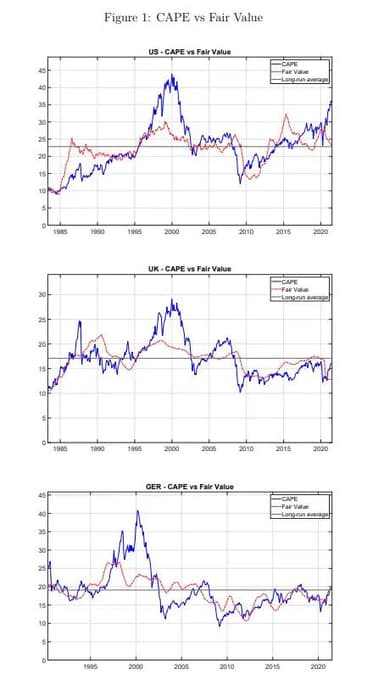
Key Insights:CAPE as a Valuation ToolThe study develops and validates a fair-value model for stock market valuation using the Cyclically Adjusted Price-to-Earnings (CAPE) ratio.CAPE is positively correlated with economic growth and negatively correlated with real interest rates and economic volatility.Macroeconomic Drivers of CAPEInterest Rates: Higher real interest rates lead to lower CAPE levels.Economic Growth: Faster-growing economies tend to have higher CAPE ratios.Economic Volatility: Increased uncertainty (e.g., fluctuations in industrial production and inflation) suppresses CAPE.Market Overvaluation and Future ReturnsWhen CAPE deviates significantly from fair value, future stock returns tend to decline.Overvalued markets, as indicated by excessive CAPE levels, are more prone to corrections.Superior Predictive Power of Fair-Value-Adjusted CAPEModels using CAPE deviations from fair value outperform those using absolute CAPE levels.Incorporating macroeconomic variables improves valuation accuracy and return predictions.Policy ImplicationsMonetary Policy: Price stability contributes to stock market stability.Fundamental-Based Investing: Long-term stock valuations should account for macroeconomic fundamentals.Conclusions:CAPE is an effective tool for assessing stock market overheating.Adjusted CAPE models incorporating macroeconomic factors enhance market predictions.Interest rates, growth, and volatility are critical for understanding valuation trends.[Compliance Note]All posts by Sellsmart are for informational purposes only. Final investment decisions should be made with careful judgment and at the investor’s own risk.The content of this post may be inaccurate, and any profits or losses resulting from trades are solely the responsibility of the investor.Core16 may hold positions in the stocks mentioned in this post and may buy or sell them at any time.
article
Neutral
Neutral
NONE
No Relevant Stock
user
박재훈투영인
·
9 months ago
0
0
Warren Buffett’s 9 Golden Investment Lessons in 2025

Warren Buffett, Chairman and CEO of Berkshire Hathaway, reminded shareholders in his annual letter that his succession to Greg Abel is imminent. Buffett emphasized that Abel fully understands Berkshire’s core values, particularly the importance of honest communication with shareholders.Buffett also highlighted Berkshire’s massive tax contribution, revealing that the company paid $26.8 billion in corporate taxes last year, accounting for 5% of all U.S. corporate taxes. He expressed hope that the U.S. government would use these funds wisely to support those in need.Reflecting on Berkshire’s financial performance, Buffett noted that 53% of its 189 operating businesses saw earnings decline in 2024, yet the company outperformed expectations due to higher Treasury yields and strong investment income.Here are nine key investment and business principles from Buffett’s latest shareholder letter:1) One great decision can change everything.Major moves like GEICO acquisition and Charlie Munger’s partnership were pivotal in Berkshire’s success.2) Stocks outperform other assets.Buffett favors owning quality businesses over holding cash.3) Great businesses and talented people endure.Companies providing essential goods/services can withstand economic turmoil.4) Degrees don’t guarantee success.Buffett values practical ability over academic credentials in leadership.5) Reinvestment beats dividends.Berkshire prioritizes compounding growth over payouts.6) Buy great stocks at bargain prices.Finding undervalued, high-quality stocks is the key to long-term gains.7) Fix mistakes quickly.Acknowledging and correcting errors swiftly prevents greater losses.8) Beware of empty optimism.Honest assessment outweighs misleading corporate rhetoric.9) America must continue to prosper.Berkshire’s success stems from a thriving U.S. economy and responsible fiscal policy.[Compliance Note]All posts by Sellsmart are for informational purposes only. Final investment decisions should be made with careful judgment and at the investor’s own risk.The content of this post may be inaccurate, and any profits or losses resulting from trades are solely the responsibility of the investor.Core16 may hold positions in the stocks mentioned in this post and may buy or sell them at any time.
article
Neutral
Neutral
NONE
No Relevant Stock
user
셀스마트 자민
·
9 months ago
0
0
Samsung Electronics Renames Its Research Center to CSS Lab, Expands Power Semiconductor Business (Mar 12, 2025)

Samsung Electronics is officially scaling down its LED business while ramping up efforts in next-generation power semiconductors. The company’s Device Solutions (DS) division has rebranded its LED Research Lab as the Compound Semiconductor Solutions (CSS) Lab, shifting its focus to R&D in silicon carbide (SiC) and gallium nitride (GaN) power semiconductors. Samsung previously restructured its LED business into the CSS division and completed a full research unit overhaul last year.CSS (Compound Semiconductor Solutions) refers to compound semiconductors, specifically materials like GaN and SiC, which are witnessing skyrocketing demand due to the expansion of electric vehicles (EVs) and the IT industry. Market research projects the GaN and SiC power semiconductor market to grow at a CAGR of 32.5%, reaching approximately $17.75 billion (25.8 trillion KRW) by 2031.Samsung is channeling its resources into GaN and SiC-based chip development, with plans to expand production and supply starting this year. Other major domestic competitors are also strengthening their presence in this field. DB HiTek is preparing to mass-produce GaN power semiconductors, while SK Inc. has acquired SK Powertech to expand its SiC power semiconductor business. With intensified investment and technological competition, the industry is expected to see continued active developments.[Compliance Note]All posts by Sellsmart are for informational purposes only. Final investment decisions should be made with careful judgment and at the investor’s own risk.The content of this post may be inaccurate, and any profits or losses resulting from trades are solely the responsibility of the investor.Core16 may hold positions in the stocks mentioned in this post and may buy or sell them at any time.
article
Neutral
Neutral
005930
Samsung Electronics
+1

user
박재훈투영인
·
9 months ago
0
0
Samsung, Are You Listening? “AI Is Booming, but It’s Ultimately in Taiwan’s Hands?” (Oct 31, 2024)
At 35, Harvard graduate Jung Yoon-seok had his pick of locations across Asia—including his home country of South Korea—to manufacture AI chips for his startup, Rebellions. Yet, he chose Taiwan. “Taiwan is small, and Taipei is even smaller, but everything moves incredibly fast there,” he says.And Jung is not alone. AI leaders like NVIDIA, Microsoft, and OpenAI are all focusing on Taiwan. They rely on Taiwanese firms to manufacture AI chips, build servers, and develop cooling systems. As a result, Taiwan’s stock market has been the hottest in Asia over the past year, led by TSMC (Taiwan Semiconductor Manufacturing Company) and Hon Hai (Foxconn).Some investors believe this $400 billion rally is just the beginning. Optimists argue that Taiwan has become the ChatGPT era’s core manufacturing hub, making it a key beneficiary of the AI boom.Former U.S. Commerce Department official Sean King puts it bluntly: “Taiwan is the engine that drives AI.”However, this success comes with risks. For the first time in decades, the global tech supply chain is shifting away from China—and instead, towards its smaller neighbor. As U.S.-China tensions escalate, many AI companies are reluctant to manufacture in China, giving Taiwan a strategic advantage. However, as Taiwan’s global significance grows, so does Beijing’s interest in reclaiming what it sees as “separated territory.”TSMC: The King of AI Chip ManufacturingTSMC is at the heart of Taiwan’s success story. As competitors Intel and Samsung struggle, TSMC has tightened its grip on the semiconductor industry, dominating the production of the world’s most advanced chips. Even NVIDIA’s CEO, Jensen Huang, acknowledges that only TSMC can manufacture its AI accelerators.But Taiwan’s AI dominance isn’t limited to TSMC. Several hidden champions play crucial roles in AI development:Quanta Computer – A key server manufacturerDelta Electronics – A leading power equipment providerAsia Vital Components (AVC) – A pioneer in computer cooling systemsThese companies are expected to thrive in the AI market, which is projected to reach $1.3 trillion by 2032.Edward Chen, chairman of First Capital Management, believes Taiwan’s AI boom will last longer than previous tech cycles. With TSMC playing a key role in choosing partners for firms like NVIDIA, he argues that Taiwan’s technology sector is reaching an entirely new level.Taiwan’s stock market performance reflects this shift. The Taiex Index has soared over 40% in the past year, far outpacing China, Hong Kong, India, and Japan.How Taiwan Became the AI Manufacturing HubTaiwan’s rise as a tech powerhouse dates back to the 1980s, when Japanese firms began outsourcing low-cost plastic toy manufacturing to Taiwan. As the economy grew, Taiwanese companies evolved into high-tech manufacturers. While some firms set up factories in China, they always kept their most advanced technologies at home.Meanwhile, U.S. trade restrictions on China have forced companies to seek alternatives, effectively pushing China out of key supply chains. In less than two years, China’s AI hardware industry has been virtually crippled.The numbers tell the story: In the first nine months of 2024, Taiwan exported more than twice the number of AI servers and GPUs as China—an unimaginable shift from just a few years ago.Why Tech Giants Are Rushing to Taiwan"Look at today’s cloud giants," says a tech analyst. "Microsoft, Amazon, Meta, and Google are all racing to catch up with ChatGPT, and they all rely on Taiwanese firms to build their servers."Market research firm IDC predicts that global spending on AI systems and services will more than double to $632 billion by 2028.Liu Fei-chen, a researcher at the Taiwan Institute of Economic Research, describes Taiwan as a “one-stop shop” for AI hardware. Companies can source everything they need without leaving the island.Put simply, Taiwan is the gateway to the AI-driven future—where global IT firms’ dreams become reality through Taiwanese technology.The Secrets of Taiwan’s SuccessWhat makes Taiwan’s tech firms so attractive to global giants like Amazon, NVIDIA, and Apple?Customer-First MentalityDuring the pandemic, TSMC had the perfect opportunity to raise chip prices but instead chose to minimize price hikes to maintain trust with customers.This “strategic, not opportunistic” approach solidified its reputation as a reliable partner.Adaptability & Quick TransformationFoxconn (Hon Hai) and Quanta were once known for assembling iPhones and MacBooks.Today, they prioritize AI server orders, proving their ability to shift with market trends.Aggressive Investment in the FutureCompanies like AVC, Delta, and Quanta allocate nearly half of their operating expenses to R&D.They are also expanding beyond Taiwan, with AVC investing $450 million in a new Vietnamese plant.Taiwan’s three-pillar strategy—customer trust, adaptability, and aggressive investment—has created an unstoppable AI powerhouse.AI’s Explosive Growth & Taiwan’s RoleAI demand is skyrocketing, but so are the challenges. NVIDIA’s latest AI server, the NVL72, costs a staggering $3 million per unit and generates extreme heat—a major technical challenge.Companies like Delta and AVC are now scrambling to develop cooling systems that can handle this unprecedented power consumption.Rodrigo Liang, CEO of Silicon Valley-based AI chip startup SambaNova Systems, highlights Taiwan’s geographic advantage:“If a startup founder flies to Taiwan looking for a manufacturing partner, they can meet Delta, AVC, and Quanta all in a single afternoon. The high-speed rail gets you from Taipei to Kaohsiung in just 1.5 hours.”This tight-knit ecosystem fosters fierce competition and rapid innovation—critical factors for Taiwan’s continued AI dominance.[Compliance Note]All posts by Sellsmart are for informational purposes only. Final investment decisions should be made with careful judgment and at the investor’s own risk.The content of this post may be inaccurate, and any profits or losses resulting from trades are solely the responsibility of the investor.Core16 may hold positions in the stocks mentioned in this post and may buy or sell them at any time.
article
Neutral
Neutral
TSM
TSMC
user
박재훈투영인
·
9 months ago
0
0
Largest Negative Price Reaction to Positive EPS Surprises Since 2011(May 20, 2022)
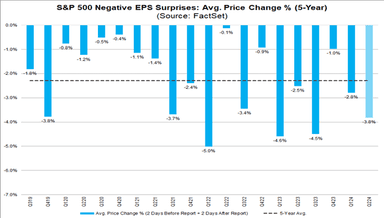
To date, 95% of the companies in the S&P 500 have reported earnings for the first quarter. Of these companies, 77% have reported actual EPS above the mean EPS estimate, which is equal to the five-year average of 77%. In aggregate, earnings have exceeded estimates by 4.7%, which is below the five-year average of 8.9%. Given this performance relative to analyst expectations, how has the market responded to positive and negative EPS surprises reported by S&P 500 companies during the Q1 earnings season?Negative Price Reactions to Positive EPS SurprisesTo date, S&P 500 companies that have reported a positive EPS surprise have seen a negative price reaction on average.Companies that have reported positive earnings surprises for Q1 2022 have seen an average price decrease of 0.5% two days before the earnings release through two days after the earnings release. This percentage decrease is well below the five-year average price increase of 0.8% during this same window for companies reporting positive earnings surprises.In fact, if this is the final percentage for the quarter, it will mark the largest average negative price reaction to positive EPS surprises reported by S&P 500 companies for a quarter since Q2 2011 (-2.1%).One example of a company that reported a positive EPS surprise in Q1 but witnessed a negative stock price reaction is Netflix. On April 19, the company reported actual EPS of $3.53 for Q1, which was well above the mean EPS estimate of $2.90. However, from April 15 to April 21, the stock price for Netflix decreased by 36.0% (to $218.22 from $341.13).Large Negative Price Reactions to Negative EPS SurprisesIn addition, S&P 500 companies that have reported negative EPS surprises have seen a much larger negative price reaction than average.Companies that have reported negative earnings surprises for Q1 2022 have seen an average price decrease of 5.4% two days before the earnings release through two days after the earnings release. This percentage decrease is much larger than the five-year average price decrease of 2.3% during this same window for companies reporting negative earnings surprises.In fact, if this is the final percentage for the quarter, it will mark the largest average negative price reaction to negative EPS surprises reported by S&P 500 companies for a quarter since Q2 2011 (-8.0%).One example of a company that reported a negative EPS surprise in Q1 and saw a substantial negative stock price reaction is Under Armour. On May 6, the company reported actual EPS of -$0.01 for Q1, which was below the mean EPS estimate of $0.04. From May 4 to May 10, the stock price for Under Armour decreased by 33.5% (to $9.59 from $14.42).Possible Explanations for the Overall Negative Price ReactionsWhy is the market not rewarding positive EPS surprises and punishing negative EPS surprises more than average?One factor may be that companies are beating estimates for Q1 2022 by a smaller margin than average compared to recent quarters. The earnings surprise percentage of 4.7% for Q1 is below both the five-year average of 8.9% and the 10-year average of 6.5%. If 4.7% is the final percentage for the quarter, it will mark the lowest earnings surprise percentage reported by the index since Q1 2020 (1.1%). Perhaps the market expected S&P 500 companies to report positive earnings surprises by similar margins as recent quarters.
article
Sell
Sell
226490
Samsung KODEX KOSPI ETF
user
박재훈투영인
·
9 months ago
0
0
How to Play the Tesla Stock Price Today Following Earnings(Aug 5, 2015)
The Tesla stock price today is down 9% in after-hours trading even after the company reported a Q3 earnings beat.Tesla Motors Inc. (Nasdaq: TSLA) reported a Q3 earnings per share (EPS) loss of $0.48, which comfortably beat the consensus projection of a $0.60 loss. Despite the beat, investors were spooked by the quarterly loss.Revenue for the quarter was $1.2 billion. That beat estimates of $1.17 billion and was a 40% increase from last year.Tesla also reported its highest production and delivery totals in the company's history. In Q2, 11,532 vehicles were delivered while 12,807 were produced. Looking ahead, the company expects to produce and deliver over 12,000 vehicles in Q3 despite the fact that its main facility will be closed for one week.How to collect up to $5,000 per month tax-free [Sponsored by Retirement Watch]The company also said that deliveries for the Model X SUV will begin in September. This is a huge step for the company, which is solely producing Model S sedans right now. Company officials have already said the vehicle will have a 90-kilowatt-hour battery and falcon-wing door.CEO Elon Musk expects production and demand between 1,600 and 1,800 vehicles per week for both the Model S and Model X in 2016.Despite many of these optimistic earnings numbers and sales figures, the Tesla stock price today is falling.Here's how we recommend playing TSLA stock now after earnings...How to Play the Tesla Stock Price TodayRetirement in a box: From zero to $2,500 a month [Sponsored by Retirement Watch]We routinely tell Money Morning readers that TSLA stock is not a perfect fit for every investor. It is not a buy for risk-averse investors.The Tesla stock price is volatile and frequently sees wide price swings. Today's 9% drop after hours is the perfect example. The company beat on both earnings and revenue, yet the stock is still down dramatically.But for investors who can buy and hold the stock for several years, the long-term potential is undeniable."I believe Tesla is one of the best long-term investments an investor can make at the moment," Money Morning Chief Investment Strategist Keith Fitz-Gerald said. "If there is ever a case to buy a few shares and tuck them away, this is it."One reason we're bullish is Tesla's home battery system.Earlier this year, Tesla announced a new line of home units built using the same lithium-ion batteries used in Tesla cars. Different models store either 7 kWh or 10 kWh of solar power. It's a major shift for Tesla, making it more than just a car company."I think Musk is the most innovative CEO on the planet and that he sees value others don't yet recognize," Fitz-Gerald said. "Cars, batteries, innovative business models - nobody knows where it will go but ultimately if you're along for the ride, I think it'd be very hard to go wrong over time."Money Morning Global Energy Strategist Dr. Kent Moors has spoken of the home battery's importance since early 2015.This new currency is making some Texans rich [Sponsored by Stansberry Research]"In everyday use, the unit is expected to allow homeowners to store solar-generated power for use during high-cost periods, giving them the flexibility to use the conventional grid for cheaper, off-peak electricity," Moors said in February.Another reason to be bullish is Tesla's new Gigafactory.Currently under construction in Nevada, the Gigafactory will be the world's largest lithium-ion battery plant upon completion.The factory is expected to take a total of $5 billion to complete. By the time it reaches full production in 2020, it should produce enough batteries to power 500,000 vehicles annually."The Gigafactory is expected to have a dramatic effect on the energy storage market, helping to bring battery costs down by as much as half by 2020," Moors said.The Bottom Line: Tesla beat on earnings and revenue in Q2, but the Tesla stock price today is still down 9% in after-hours trading. Tesla stock is always volatile when news is released, and today is the perfect example. For long-term investors, today's dip is an excellent buying opportunity. This stock has plenty of long-term potential and is great for investors who can take on some short-term risk.
article
Sell
Sell
TSLA
Tesla
user
박재훈투영인
·
9 months ago
0
0
The Flawed Fed Valuation Model(Feb 5, 2008)
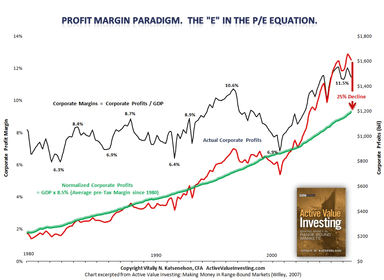
There are lots of things that investors believe which I find perplexing. The Superbowl indicator is one, but the oddest to me is the so-called Fed Model, also known as the IBES Valuation Model.It is not that the Fed model is so terribly wrong — it has been both right and wrong over the years. Rather, it is the way too many people conceptualize it.First, the definition of the Fed Model: Yield on the 10-year U.S. Treasury Bonds should be similar to the S&P 500 earnings yield (forward earnings divided by the S&P price). This, in theory, should inform you of when equities are over-priced or under-priced.Note that the formula contains two variables: While it is commonly described as a way to evaluate when stocks are over- or under-valued, the other variable in the formula above is the forward S&P500 earnings consensus. SPX prices and the 10 year yield are the knowns, while BOTH valuation and forward earnings estimates are the unknowns.Thus, the Fed model today might be telling you either of two things: When equities are undervalued — or when consensus earning estimates are simply too high.Let’s see how that looks on a chart:Looking at the chart above, we can identify some rather odd periods. The model had stocks extremely undervalued in 1979 — just before a major 30% selloff. In 1981, stocks were fairly valued on the eve of the greatest bull market in history. From 1982-85, stocks bounced between slightly overvalued to undervalued, according to the model.  In 1987, a very timely crash warning. 1998, an extremely early crash warning, missing a huge 2 year run in the indices. In 2001, it had stocks as undervalued — and they proceeded to get a whole lot cheaper over the next 2 years. Equities have been extremely undervalued ever since.Now, given that rather inconsistent track record, I find it hard to get too excited about this. But the most damning evidence against the Fed model is the period prior to 1960s. Over that entire, the Fed model had no utility whatsoever. “Out of sample” testing — looking at a different set of data than the one proffered — is quite damning to the Fed model.Which brings us back to today. We continue to see the Fed model used to rationalize a bullish stance in equities. However, given that it is based in large part on analysts consensus for future SPX earnings, investors need to be extremely cautious relying solely on the Fed model. Why? Analysts are unflaggingly inaccurate at turning points. Example: Q3 S&P500 earnings consensus were +8% — S&P500 earnings came in at -8%. Q4 has been similarly lowered, undercutting the earlier forecasts of undervaluation.Now let’s look at 2008. S&P 500 forward earnings over the next 4 quarters are as follows: Q1 = 3%; Q2 = 4%; Q3 = 20%; Q4 = 50%, according to UBS.So stocks, so we are confronted with two possibilities. Perhaps, equities are seriously undervalued (that assumes earnings  explode in 2H). An alternative explanation, and one I suspect is more likely: Analysts consensus earnings are wildly exuberant for the second half.One last issue: Let’s ignore the analysts, and merely  consider mean reversion: As the chart below shows, earnings have been unusually high relative to history. If they merely mean revert, they will come down another 25%. Even worse, most mean reversion blows right past historical averages to opposite extremes.
article
Sell
Sell
133690
Mirae Asset TIGER NASDAQ100 ETF
user
박재훈투영인
·
10 months ago
0
0
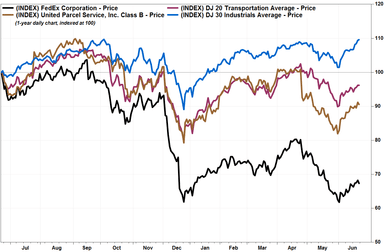
FedEx earnings: EPS guidance and conference call to overshadow Q4 results(Jun 25, 2019 )
FedEx Corp. is scheduled to report fiscal fourth-quarter results on Tuesday after the closing bell, but what the package delivery giant says about the future will be of much more interest to Wall Street than what it says about the past three months.Investors have good reason to be worried about what’s coming for them in FedEx’s report.Most analysts remain bullish on FedEx over the longer term, but they have become less so in recent months. Earnings and revenue estimates and stock price targets have been slashed on concerns over a slowdown in the global economy, particularly in China and Europe.Those concerns are being exacerbated by the Trump administration’s contentious trade policy. FedEx has indicated that changes in U.S. policy have resulted in several governments, including China, the European Union and India, imposing retaliatory tariffs, which may reduce demand and hurt global trade and economic activity.And although some analysts believe FedEx’s decision announced on June 7 to end its Express unit’s domestic contract with Amazon.com Inc. could help improve margins, as it allows the company to add higher-margin business-to-business customers, the need to do so is a little worrisome. Especially since FedEx’s declaration on June 10 of a quarterly dividend that was unchanged from a year ago, effectively snapped a 10-year streak of rising dividends.Analyst Patrick Brown at Raymond James said the non-raise “could prove a telling sign,” given mounting macro uncertainty, sluggish volume trends and FedEx’s need to refresh its aircraft fleet and make ongoing e-commerce investments.Brown kept his rating on FedEx at outperform, but lowered his stock price target to $200 from $215, cut his adjusted earnings-per-share estimate for fiscal 2020 to $15.50 from $17.10 and lowered his revenue forecast to $70.76 billion from $72.77 billion.Among other investor concerns, The Wall Street Journal reported on Monday, citing people familiar with the matter, that FedEx was offering big discounts as it tries to get online merchants to switch over from rival United Parcel Service Inc. And late Monday, FedEx filed suit against the U.S. Department of Commerce, saying the Export Administration Regulations (EAR) against FedEx violates common carriers’ rights, as it holds FedEx liable for shipments that violate the EAR without requiring evidence that FedEx had any knowledge of violations.“FedEx is a transportation company, not a law enforcement agency,” the company said in a statement.But perhaps the biggest reason for investors to worry is FedEx’s recent history of disappointing earnings reports. The stock has declined on the day after results were reported the past five quarters, by an average of 5.0% (median of 3.5%). Those disappointments have come despite earnings beats in three of the five quarters and revenue beats in four.J.P. Morgan analyst Brian Ossenbeck suggested that as much as the latest quarter’s results, his key questions regarding the report will include 2020 earnings guidance and management comments on the “much anticipated” post-earnings conference call. He cut his stock price target to $184 from $202 and his 2020 adjusted EPS estimate to $15.32 from $16.79.“Our lowered estimates and target price join the cavalcade of sell-side cuts over the last month that attempt to capture fundamental weakness and a string of strategic decisions within Express and Ground,” Ossenbeck wrote in a note to clients.Don’t miss: FedEx just fired off a warnings investors may not be able to ignore.Here’s what to expect:Earnings: The average analyst EPS estimate for the quarter ended May, as compiled by FactSet, is $4.85, which is down from $5.91 in the same period a year ago. The FactSet consensus has declined steadily this year, from $4.93 at the end of March and $5.32 at the end of December.For fiscal 2020, the FactSet EPS consensus is $16.23. That’s down from $16.82 at the end of March and $17.99 at the end of 2018.Estimize, a crowdsourcing platform that gathers estimates from buy-side analysts, hedge-fund managers, company executives, academics and others, as well as from Wall Street analysts, has a fourth-quarter consensus EPS estimate of $4.85.Revenue: The FactSet revenue consensus is $17.80 billion, up from $17.30 billion a year ago. That includes a $9.46 billion consensus for FedEx Express, a $5.20 billion consensus for FedEx Ground and a $2.01 billion estimate for FedEx Freight.Estimize is projecting revenue of $17.91 billion.For 2020, the FactSet consensus is for revenue of $72.13 billion.Stock price: FedEx’s stock has lost 8.8% over the past three months, and 33.1% the past 12 months. That makes it the worst performing stock in the Dow Jones Transportation Average over the past year.In comparison, shares of rival UPS have lost 11.2% the past 12 months, while the Dow transports have eased 3.8% and the Dow Jones Industrial Average has gained 9.9%.Of the 27 analysts surveyed by FactSet, 19 rate the stock the equivalent of overweight, or buy, while 7 rate it the equivalent of hold and 1 rates it the equivalent of sell. That makes the average rating overweight.The average stock price target is $195.79, which is about 25% above current levels, but down from the average target of $210.50 as of the end of March and $229.96 at the end of 2018.
article
Sell
Sell
FDX
Fedex
user
박재훈투영인
·
10 months ago
0
0
Caterpillar’s Fortunes Are Tied to Those of the Global Economy(Oct 29, 2019)
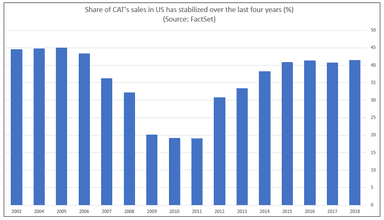
In Caterpillar’s 3Q 2019 earnings call, the company announced a 6% year-over-year drop in sales and revenues for the third quarter, the first quarterly decline in nearly three years. CEO Jim Umpleby attributed the decline to a sharp reduction in dealer inventories in anticipation of lower end-user demand. The company also cut its forecasts for 2019 annual results based on an assumption of continued reductions in dealer inventories and flat customer demand through the fourth quarter.Umpleby cited “uncertainty in the global economic environment” as the primary reason for the increased caution exhibited by both dealers and end-users. Caterpillar breaks down its revenue into four regions: North America, Latin America, EAME, and Asia Pacific. In the third quarter, only Latin America saw an increase in sales and revenues; however, this region accounts for less than 10% of CAT’s total revenues. Sales in the Asia Pacific region shrank by 14% during the quarter, which includes a 29% plummet in sales to construction industries. Umpleby noted that the weakness in the Asia Pacific is outside of their main markets in China and Japan.Caterpillar’s results confirm the most recent global analysis from the International Monetary Fund (IMF). The IMF’s October World Economic Outlook shows global GDP growth slowing from 3.6% in 2018 to 3.0% in 2019 and 3.4% in 2020; these projections are significantly lower than the organization’s July’s interim projections. A 3.0% growth rate would be the slowest global growth since the 2008-2009 global economic slowdown. According to the IMF, risks to the global growth outlook skew to the downside as trade barriers and heightened geopolitical tensions disrupt global supply chains and hamper confidence, investment, and growth. This is a negative sign for Caterpillar and other global companies.Persistent alarmist news about tariffs and potential trade wars over the last two years has hurt CAT’s stock. After peaking in early 2018, we have seen a general downward movement in Caterpillar’s stock price (CAT), characterized by dramatic swings in response to news events including the imposition of tariffs on steel and aluminum imports as well as the ups and downs of the U.S.-China trade war. CAT is one of the 30 companies in the Dow Jones Industrial Average and every time it moves, it brings the entire index with it. As of October 28, CAT is down 18% from its January 22, 2019 peak ($170.89).In 2018, foreign sales accounted for 58.5% of CAT’s total revenue, but this statistic only gives you part of the story. In Q3 2019, 21% of Caterpillar’s revenue was generated in the Asia Pacific region; in fact, FactSet estimates that 5.1% of total revenue is from China. After the United States and Canada, China is the company’s third-biggest market.We can take this global analysis even further. By extracting relationship disclosures from thousands of companies worldwide, FactSet has identified 159 suppliers, 65 customers, and 27 partners that do business with Caterpillar, representing 38 countries around the world. Digging deeper into these numbers, 60.4% of suppliers, 62.5% of customers, and 66.7% of partners are located outside of the United States. Caterpillar has developed a truly global supply chain.In addition, the company employs thousands of people around the world. According to Caterpillar, the company serves 193 countries through its dealer network. The company’s 2018 annual report states that, “we employed about 104,000 full-time persons of whom approximately 59,400 were located outside the United States.”Will Caterpillar Be Able to Weather This Storm?For a company selling large, expensive industrial machinery both domestically and abroad, a global slowdown in industrial activity is a concern. However, Caterpillar and its leadership are well-known for their ability to successfully navigate through troubled economic conditions. Despite the weak third quarter performance and downgrade to the outlook, Caterpillar saw a 1.2% increase in its stock price when it released 3Q earnings on October 23. Analysts appear to have been reassured by the company’s continued strong margins and focus on its cost structure. Undoubtedly, this global powerhouse will find a way to persevere despite growing business obstacles, but the next couple of years are likely to be challenging.
article
Sell
Sell
241180
Mirae Asset TIGER NIKKEI225 ETF
+2
user
박재훈투영인
·
10 months ago
0
0
Is Apple Stock (Nasdaq: AAPL) the Short of a Lifetime or the New Widow Maker?(March 27, 2012)
I have a confession to make.I believe Apple stock (Nasdaq: AAPL) is going to be world's first trillion-dollar company yet I want to short the snot out of it.Am I being compulsive?...impulsive?....or foolish?Perhaps it is all three considering that Apple has risen more than 3,000% in the last ten years, turning almost any attempt to go against the grain into a "widow maker" trade.Trump boom awakens “silent” $2 stock [Sponsored by Timothy Sykes]I say almost because I am one of the lucky ones.A few weeks ago I recommended my Strike Force subscribers purchase put options on Apple, effectively shorting the stock. That resulted in a 47% profit in less than 24 hours for anyone who followed along, excluding fees and commissions.I'm not alone in my thinking.Why Buffett, Bezos, & Congress Are Piling Into This One Sector [Sponsored by Investorplace]Uber investor Doug Kass, general partner of Seabreeze Partners Long/Short LP and Seabreeze Partners Long/Short Offshore LP, tweeted recently that he had covered "half his short" on Apple following the announcement of their dividend and buyback plan.Given that the stock had run up to nearly $608 a share before the announcement, presumably Kass had banked some gains, too.7 Reasons to Short Apple Stock(Nasdaq: AAPL)I haven't spoken with Mr. Kass so I can't comment on his current thinking nor the specifics of his trade, but here are mine:The company has single-handedly repeated the bubble curve of the Nasdaq run up. That leaves a lot of empty space to the downside.Apple is a "fad" or a "hit" company, meaning that its price seems to correlate to new product launches rather than the sustainable development of key product lines. Companies that do that tend to fall back from orbit at some point - especially in the tech world. Palm and Research in Motion (Nasdaq: RIMM) are two that come to mind.When great leaders are gone, their legacies can struggle. While Apple has stood up so far following Steve Jobs' unfortunate death, I can only wonder, as many in the tech community are wondering, how deep and how far out his thinking will live on. Is it one product cycle, two cycles? Nobody knows. But we do know that Microsoft (Nasdaq: MSFT) became a very different company after Bill Gates stepped aside. Intel (Nasdaq: INTC) also flatlined three or four cycles after Andy Grove's departure from day-to-day operations.Apple's short interest of only 9.8 million shares is very low considering the company's three-month average daily trading volume is 18.2 million shares and the company's float is 931.8 million shares.The analyst community is almost completely positive. That's usually a sign of two things: a) that they're soft peddling opposing trades from other parts of the "shops" they work for or b) that they want a run up to maximize profits from positions they already hold. Either way, many have been tremendously wrong in their sales projections in recent quarters, understating anticipated results by as much as 30%-40% - a factor also noted by Kass in his trade set up analysis. Therefore, I am skeptical that they are raising numbers again.Apple's profit margins are unbelievably high at a time when the rest of the economy lurches along. While that's not a bad thing in isolation, I have a hard time believing that Apple can remain so far out of line if for no other reason that what goes up must come down eventually. And, since the road higher is far more unlikely for the rest of the markets, it is logical that Apple likely heads lower in the short term.Apple's fundamentals may soften. There are lots of reasons to love Apple but there are just as many reasons things may not be what they seem. If the economy worsens just how many people are going to buy "gee-whiz" technology beyond the hard core Apple-heads? Is there an Apple-killer in somebody's garage right now? Anti-trust investigations and supply problems are also big what ifs at the moment. Even a carrier failure could rock Apple because it may be their subsidies that keep Apple's costs down and profits high.Add it all up and there is enough to make you go hmmm...Of course, there is no doubt I will incur the wrath of Apple fans everywhere and arm chair traders from here to Tibet.Trump’s Shocking Exec Order 001 [Sponsored by Bayan Hill]Get over it guys; please refrain from the snarky e-mails telling me I'm an idiot or out of touch or worse - I believe in Apple. I really do.What I am suggesting is simply the logic behind Apple as a trading opportunity for nimble, aggressive and like minded market mavens.Besides, if I am correct and Apple does trade lower in the weeks ahead, I'm going to be picking up shares as an investment.
article
Sell
Sell
226490
Samsung KODEX KOSPI ETF
+2
user
박재훈투영인
·
10 months ago
0
0
Dow soars into history(March 16, 2000)
Strong Sell
Strong Sell
133690
Mirae Asset TIGER NASDAQ100 ETF
+3
user
박재훈투영인
·
10 months ago
0
0
Dow soars into history(March 16, 2000)
NEW YORK (CNNfn) - The Dow Jones industrial average rose a record 499.19 points Thursday, lifted as money poured into "old economy" stocks out-of-favor for much of the year. The blue-chip euphoria lifted the world's best-known index out of the hole that Wall Street considers a correction, handing the New York Stock Exchange its busiest trading day on record.    Investors made heroes out of stocks such as American Express, J.P. Morgan and Minnesota Mining & Manufacturing - all down by double digits in the last three months.    The gains came after a batch of tame inflation figures eased Wall Street's worst fears about sharply higher interest rates to come, boosting expectations for strong corporate profits ahead.    "The rumors of the Dow's death has been much exaggerated," Art Hogan, chief market strategist at Jefferies & Co., told CNN's Street Sweep.    Less than two weeks ago a surprise profit warning from Procter & Gamble knocked 375 points off the Dow.    That seemed a distant memory Thursday, with the blue chip frenzy lifting 29 of the Dow's 30 stocks and spreading to the Nasdaq composite index, which broke a three-session losing streak. Only Dow member Microsoft, the world's most valuable company, failed to rise.    "It's phenomenal," said Charles Payne, head analyst at Wall Street Strategies. "We're breaking all sorts of technical resistance levels like a hot knife through butter."    But Goldman Sachs' Abby Joseph Cohen told CNNfn on Moneyline that investors should not look at this phenomenal rise as a trend for the year. (235K WAV or 235K AIFF)    The Dow soared 499.19 points, or more than 4.9 percent, to 10,630.60. The gain shattered the previous record, a 380.53-point rise set Sept. 8, 1998. With the day's action, the index is now about 9.3 percent below its all-time high of 11,722 set Jan. 14, pushing it below the 10 percent dip Wall Street deems a correction.    Lifted by data    The Dow's rise began with the start of trading, when a tame rise in producer price data failed to confirm analysts' worst fears about climbing inflation. Analysts said the news suggests only modest interest rate hikes lie ahead.    "I don't see (the economy) overheating," Wall Street Strategies' Payne said. "We've got strong growth and controlled growth. "There still isn't any clear-cut sign of inflation."    The Nasdaq, meanwhile, reversed a 127-point loss earlier in the session, rising 134.66, or 2.9 percent, to 4,717.76. That broke three-sessions of double-digit losses.Charles Lemonides, chief investment officer at M&R capital, told CNNfn that the day's action could be the beginning of a broad market advance, countering the narrow gains seen only by the Nasdaq.    The day's action supported that. The broader S&P 500 catapulted 64.66, or 4.7 percent, to 1,456.63.    And more stocks rose than fell. Advancers on the New York Stock Exchange swamped decliners 2,414 to 410 as trading volume topped 1.48 billion shares, a record. Nasdaq winners beat losers 2,259 to 2,004 with more than 2 billion shares changing hands.    In other markets, the dollar fell against the euro and was little changed versus the yen. Treasury securities rose.    Dow flexes muscles    The Dow's jump of more than 800 points in the last two sessions comes as investors fish for some of the cheapest of blue-chip stocks.    Among the big drivers, American Express (AXP: Research, Estimates) rocketed 10-7/8 to 143-3/4, J.P. Morgan  (JPM: Research, Estimates) surged 7-1/8 to 124-5/8 and Minnesota Mining & Manufacturing (MMM: Research, Estimates) catapulted 5-9/16 to 88-1/16.    "A lot of these stocks were much higher a year ago than they are today," Ned Riley, chief investment strategist at State Street Global Advisors, told CNN's In the Money. "Clearly, the bottom-fishing issue is important and real."    Still, Paul Rabbitt, president of Rabbitt Analytics, told CNNfn's Talking Stocks he sees the Nasdaq resuming its lead as investors chase the highest growth tech companies. (408K WAV) (408K AIFF).    Even after the day's action, the Dow is still down 7.5 percent this year while the Nasdaq is up 15.9 percent in 2000.    But on Thursday, Nasdaq leaders surged alongside old economy stalwarts.    Oracle (ORCL: Research, Estimates) jumped 3-5/8 to 81-15/16, Intel (INTC: Research, Estimates) rose 4-7/8 to 125-1/16, and JDS Uniphase (JDSU: Research, Estimates) rocketed 10-11/16 to 129-7/16.    But Microsoft  (MSFT: Research, Estimates), failed to rise, ending unchanged at 95-3/8.    Inflation-friendly data    Blue-chip stocks found support after the latest batch of economic indicators suggested inflation remains tame enough to keep the Federal Reserve from aggressively tightening credit, boosting expectations for strong corporate profits.    While producer prices posted their biggest monthly jump in more than nine years in February, the core rate, which excludes volatile food and energy costs, advanced at a more moderate pace of rose 0.3 percent.    "Inflation appears to be muted," said Alan Ackerman, senior vice president at Fahnestock & Co.    Separately, the Commerce Department reported that housing starts rose 1.3 percent to a 1.78 million-unit rate in February, suggesting the housing market remains strong, undeterred by the Fed's four rate hikes since June. Finally, the number of Americans filing new claims for unemployment benefits fell to 262,000 for the week ended March 11, the Labor Department said. 
article
Strong Sell
Strong Sell
133690
Mirae Asset TIGER NASDAQ100 ETF
+3
user
박재훈투영인
·
10 months ago
0
0
Worst Crisis Since '30s, With No End Yet in Sight(Sept. 18, 2008)
The financial crisis that began 13 months ago has entered a new, far more serious phase.Lingering hopes that the damage could be contained to a handful of financial institutions that made bad bets on mortgages have evaporated. New fault lines are emerging beyond the original problem -- troubled subprime mortgages -- in areas like credit-default swaps, the credit insurance contracts sold by American International Group Inc. and others. There's also a growing sense of wariness about the health of trading partners.The consequences for companies and chief executives who tarry -- hoping for better times in which to raise capital, sell assets or acknowledge losses -- are now clear and brutal, as falling share prices and fearful lenders send troubled companies into ever-deeper holes. This weekend, such a realization led John Thain to sell the century-old Merrill Lynch & Co. to Bank of America Corp. Each episode seems to bring government intervention that is more extensive and expensive than the previous one, and carries greater risk of unintended consequences.Expectations for a quick end to the crisis are fading fast. "I think it's going to last a lot longer than perhaps we would have anticipated," Anne Mulcahy, chief executive of Xerox Corp. , said Wednesday."This has been the worst financial crisis since the Great Depression. There is no question about it," said Mark Gertler, a New York University economist who worked with fellow academic Ben Bernanke, now the Federal Reserve chairman, to explain how financial turmoil can infect the overall economy. "But at the same time we have the policy mechanisms in place fighting it, which is something we didn't have during the Great Depression."Spreading DiseaseThe U.S. financial system resembles a patient in intensive care. The body is trying to fight off a disease that is spreading, and as it does so, the body convulses, settles for a time and then convulses again. The illness seems to be overwhelming the self-healing tendencies of markets. The doctors in charge are resorting to ever-more invasive treatment, and are now experimenting with remedies that have never before been applied. Fed Chairman Bernanke and Treasury Secretary Henry Paulson, walking into a hastily arranged meeting with congressional leaders Tuesday night to brief them on the government's unprecedented rescue of AIG, looked like exhausted surgeons delivering grim news to the family.Fed and Treasury officials have identified the disease. It's called deleveraging, or the unwinding of debt. During the credit boom, financial institutions and American households took on too much debt. Between 2002 and 2006, household borrowing grew at an average annual rate of 11%, far outpacing overall economic growth. Borrowing by financial institutions grew by a 10% annualized rate. Now many of those borrowers can't pay back the loans, a problem that is exacerbated by the collapse in housing prices. They need to reduce their dependence on borrowed money, a painful and drawn-out process that can choke off credit and economic growth.At least three things need to happen to bring the deleveraging process to an end, and they're hard to do at once. Financial institutions and others need to fess up to their mistakes by selling or writing down the value of distressed assets they bought with borrowed money. They need to pay off debt. Finally, they need to rebuild their capital cushions, which have been eroded by losses on those distressed assets.But many of the distressed assets are hard to value and there are few if any buyers. Deleveraging also feeds on itself in a way that can create a downward spiral: Trying to sell assets pushes down the assets' prices, which makes them harder to sell and leads firms to try to sell more assets. That, in turn, suppresses these firms' share prices and makes it harder for them to sell new shares to raise capital. Mr. Bernanke, as an academic, dubbed this self-feeding loop a "financial accelerator.""Many of the CEO types weren't willing...to take these losses, and say, 'I accept the fact that I'm selling these way below fundamental value,'" said Anil Kashyap, a University of Chicago Business School economics professor. "The ones that had the biggest exposure, they've all died."Deleveraging started with securities tied to subprime mortgages, where defaults started rising rapidly in 2006. But the deleveraging process has now spread well beyond, to commercial real estate and auto loans to the short-term commitments on which investment banks rely to fund themselves. In the first quarter, financial-sector borrowing slowed to a 5.1% growth rate, about half of the average from 2002 to 2007. Household borrowing has slowed even more, to a 3.5% pace.Not EnoughGoldman Sachs Group Inc. economist Jan Hatzius estimates that in the past year, financial institutions around the world have already written down $408 billion worth of assets and raised $367 billion worth of capital.But that doesn't appear to be enough. Every time financial firms and investors suggest that they've written assets down enough and raised enough new capital, a new wave of selling triggers a reevaluation, propelling the crisis into new territory. Residential mortgage losses alone could hit $636 billion by 2012, Goldman estimates, triggering widespread retrenchment in bank lending. That could shave 1.8 percentage points a year off economic growth in 2008 and 2009 -- the equivalent of $250 billion in lost goods and services each year."This is a deleveraging like nothing we've ever seen before," said Robert Glauber, now a professor of Harvard's government and law schools who came to Washington in 1989 to help organize the savings and loan cleanup of the early 1990s. "The S&L losses to the government were small compared to this."Hedge funds could be among the next problem areas. Many rely on borrowed money to amplify their returns. With banks under pressure, many hedge funds are less able to borrow this money now, pressuring returns. Meanwhile, there are growing indications that fewer investors are shifting into hedge funds while others are pulling out. Fund investors are dealing with their own problems: Many have taken out loans to make their investments and are finding it more difficult now to borrow.That all makes it likely that more hedge funds will shutter in the months ahead, forcing them to sell their investments, further weighing on the market.Debt-driven financial traumas have a long history, from the Great Depression to the S&L crisis to the Asian financial crisis of the late 1990s. Neither economists nor policymakers have easy solutions. Cutting interest rates and writing stimulus checks to families can help -- and may have prevented or delayed a deep recession. But, at least in this instance, they don't suffice.In such circumstances, governments almost invariably experiment with solutions with varying degrees of success. President Franklin Delano Roosevelt unleashed an alphabet soup of new agencies and a host of new regulations in the aftermath of the market crash of 1929. In the 1990s, Japan embarked on a decade of often-wasteful government spending to counter the aftereffects of a bursting bubble. President George H.W. Bush and Congress created the Resolution Trust Corp. to take and sell the assets of failed thrifts. Hong Kong's free-market government went on a massive stock-buying spree in 1998, buying up shares of every company listed in the benchmark Hang Seng index. It ended up packaging them into an exchange-traded fund and making money.Taking Out the PlaybookToday, Mr. Bernanke is taking out his playbook, said NYU economist Mr. Gertler, "and rewriting it as we go."Merrill Lynch & Co.'s emergency sale to Bank of America Corp. last weekend was an example of the perniciousness and unpredictability of deleveraging. In the past year, Merrill had hired a new chief executive, written off $41.4 billion in assets and raised $21 billion in equity capital.But Merrill couldn't keep up. The more it raised, the more it was forced to write off. When Merrill CEO John Thain attended a meeting with the New York Fed and other Wall Street executives last week, he saw that Merrill was the next most vulnerable brokerage firm. "We watched Bear and Lehman. We knew we could be next," said one Merrill executive. Fearful that its lenders would shut the firm off, he sold to Bank of America.This crisis is complicated by innovative financial instruments that Wall Street created and distributed. They're making it harder for officials and Wall Street executives to know where the next set of risks is hiding and also contributing to the crisis's spreading impact.Swaps GameThe latest trouble spot is an area called credit-default swaps, which are private contracts that let firms trade bets on whether a borrower is going to default. When a default occurs, one party pays off the other. The value of the swaps rise and fall as the market reassesses the risk that a company won't be able to honor its obligations. Firms use these instruments both as insurance -- to hedge their exposures to risk -- and to wager on the health of other companies. There are now credit-default swaps on more than $62 trillion in debt, up from about $144 billion a decade ago.One of the big new players in the swaps game was AIG, the world's largest insurer and a major seller of credit-default swaps to financial institutions and companies. When the credit markets were booming, many firms bought these instruments from AIG, believing the insurance giant's strong credit ratings and large balance sheet could provide a shield against bond and loan defaults. AIG believed the risk of default was low on many securities it insured.As of June 30, an AIG unit had written credit-default swaps on more than $446 billion in credit assets, including mortgage securities, corporate loans and complex structured products. Last year, when rising subprime-mortgage delinquencies damaged the value of many securities AIG had insured, the firm was forced to book large write-downs on its derivative positions. That spooked investors, who reacted by dumping its shares, making it harder for AIG to raise the capital it increasingly needed.One pleasant mystery is why the crisis hasn't hit the economy harder -- at least so far. "This financial crisis hasn't yet translated into fewer...companies starting up, less research and development, less marketing," Ivan Seidenberg, chief executive of Verizon Communications, said Wednesday. "We haven't seen that yet. I'm sure every company is keeping their eyes on it."At 6.1%, the unemployment rate remains well below the peak of 7.8% in 1992, amid the S&L crisis.In part, that's because government has reacted aggressively. The Fed's classic mistake that led to the Great Depression was that it tightened monetary policy when it should have eased. Mr. Bernanke didn't repeat that error. And Congress moved more swiftly to approve fiscal stimulus than most Washington veterans thought possible.In part, the broader economy has held mostly steady because exports have been so strong at just the right moment, a reminder of the global economy's importance to the U.S. And in part, it's because the U.S. economy is demonstrating impressive resilience, as information technology allows executives to react more quickly to emerging problems and -- to the discomfort of workers -- companies are quicker to adjust wages, hiring and work hours when the economy softens.But the risk remains that Wall Street's woes will spread to Main Street, as credit tightens for consumers and business. Already, U.S. auto makers have been forced to tighten the terms on their leasing programs, or abandon writing leases themselves altogether, because of problems in their finance units. Goldman Sachs economists' optimistic scenario is a couple years of mild recession or painfully slow economy growth.
article
Strong Sell
Strong Sell
133690
Mirae Asset TIGER NASDAQ100 ETF
user
박재훈투영인
·
10 months ago
0
0
Goldman Sachs: The economy needs to slow down to avoid a ‘dangerous overheating’ (Nov 5 2018)
A thriving labor market is part of a continuing economic boom that will have to slow down or it eventually will cause trouble, according to a Goldman Sachs analysis.Nonfarm payrolls rose by 250,000 in October and the unemployment rate held at a 49-year low of 3.7 percent, according to Labor Department data released Friday. On top of that, average hourly earnings rose 3.1 percent from the same period a year ago, the fastest pace during the post-Great Recession recovery.While that’s all good news, concerns are now rising about the pace of gains.The Federal Reserve estimates that the natural rate of unemployment is around 4.5 percent, which Jan Hatzius, Goldman’s chief economist, calls “broadly reasonable.” Looking down the road, Goldman sees unemployment falling to 3 percent by early 2020 and wage growth to hit the 3.25 percent to 3.5 percent range over the next year or so.“So the economy really needs to slow to avoid a dangerous overheating,” Hatzius said in a note that pointed out some signs are emerging of a cooling.What matters next is how the data feed into the broader growth picture.Hatzius said inflation “is on track for a meaningful overshoot” of the Fed’s 2 percent mandated target, up to 2.3 percent, which would be “within the Fed’s likely comfort zone. But we see the risks to this forecast as tilted to a bigger increase.”Those higher inflation risks are coming from the gains being documented in the labor market, as well as tariffs that are raising the cost of imports, the note said.“Labor market tightness is moving to levels rarely seen in postwar history at the national level, and our analysis of city-level data suggests that such extreme readings typically push inflation notably, not just slightly, higher,” Hatzius said.The Fed has been responding to the pickup in inflation expectations by raising rates and indicating that it will continue to do so through 2019. In fact, Goldman says the central bank will have to be even more aggressive than the market thinks. The firm is forecasting five more quarter-point rate hikes through early 2020, which would be two more than traders are pricing, and said risks to that forecast also are “a little tilted to the upside.”The Fed meets Wednesday and Thursday and is not expected to take any action on the benchmark funds rate, which is set in a range between 2 percent and 2.25 percent. Markets are currently pricing in a December move, followed by two more in 2019.Policymakers may choose to tip off the next rate and could include language in the post-meeting statement to indicate where they think growth is heading and how that figures into longer-range actions. Central bank officials also may address the recent spate of market volatility.
article
Neutral
Neutral
133690
Mirae Asset TIGER NASDAQ100 ETF
user
박재훈투영인
·
10 months ago
0
0
Bleakonomics(March 30, 2008)
Strong Sell
Strong Sell
133690
Mirae Asset TIGER NASDAQ100 ETF
user
박재훈투영인
·
10 months ago
0
0
Bleakonomics(March 30, 2008)
Since the bank runs of the 1930s, federal protection of retail depositor institutions has been a hallmark of American capitalism. The Federal Reserve, in a sweeping extension, has now extended the privilege to gilt-edged investment firms.Its flurry of interventions has prompted a double dose of unease. The central bank offered a lifeline to Wall Street investors who, seemingly, deserved a worse fate. And it arguably interrupted the cycle of boom, bust and renewal that leads to a durable recovery.What is the true value of Bear Stearns? If the government-orchestrated takeover of Bear goes through as planned, we will never know. As with Bear, so with the billions of dollars of mortgage securities for which the central bank has suddenly become an eager customer. So, too, perhaps, with the nation’s stock of residential homes — the prices of which, instead of reverting to more realistic values, will get a boost from the Fed’s repeated rounds of interest rate-cutting.Government interventions always bring disruptions, but when Washington meddles in financial markets, the potential for the sort of distortion that obscures proper incentives is especially large, due to our markets’ complexities. Even Robert Rubin, the Citigroup executive and former Treasury secretary, has admitted he had never heard of a type of contract responsible for major problems at Citi.Bear is a far smaller company, and, it would seem, far simpler. But consider that as recently as three weeks ago, it was valued at $65 a share. Then, as it became clear that Bear faced the modern equivalent of a bank run,JPMorgan Chase negotiated a merger with the figure of $10 a share in mind. Alas, at the 11th hour, Morgan’s bankers realized they couldn’t get a handle on what Bear owned — or owed — and got cold feet. Under heavy pressure from the Fed and the Treasury, a deal was struck at the price of a subway ride — $2 a share.It is safe to say that neither Jamie Dimon, Morgan’s chief executive, nor Ben Bernanke, the Fed chairman who pushed for the deal, know what Bear is really worth. For the record, Bear’s book value per share is $84. As Meredith Whitney, who follows Wall Street for Oppenheimer, remarked, “It’s hard to get a linear progression from 84 to 2.”Capitalism isn’t supposed to work like this, and before the advent of modern finance, it usually didn’t. Market values fluctuate, but — in the absence of fraud — billion-dollar companies do not evaporate. Yet it’s worth noting that Lehman Brothers’ stock also fell by half and then recovered within a 24-hour span. Once, investors could get a read on financial firms’ assets and risks from their balance sheets; those days are history.Firms now do much of their business off the balance sheet. The swashbuckling Bear Stearns was a party to $2.5 trillion — no typo — of a derivative instrument known as a credit default swap. Such swaps are off-the-books agreements with third parties to exchange sums of cash according to a motley assortment of other credit indicators. In truth, no outsider could understand what Bear (or Citi, or Lehman) was committed to. The thought that Bear’s counterparties (the firms on the other side of that $2.5 trillion) would call in their chits — and then cancel their trades with Lehman, perhaps with Merrill Lynch and so forth — sent Wall Street into panic mode. Had Bear collapsed, or so asserted a veteran employee, “it would have been the end: pandemonium and global meltdown.”It is true that Bear’s shareholders have suffered steep losses. But the Fed went much further than in previous episodes to calm the waters. Notably, it announced it would accept mortgage securities as collateral for loans — enlarging its role as lender of last resort. (Wall Street jesters had it that the Fed would also be accepting “cereal box-tops.”) Then the Fed extended a backstop line of credit to JPMorgan to tide Bear over; finally, it agreed to absorb the ugliest $30 billion of Bear’s assets.Government rescues are as old as private enterprise itself, but we are well beyond the days of guaranteeing loans to stodgy manufacturers à la Chrysler and Lockheed. Those cases were contained; the borders of finance are more nebulous. However pure of motive, Bernanke & Co. are underwriting overleveraged markets whose linkages, even today, are dimly understood. The formula of laissez faire in advance and intervention in the aftermath has it exactly wrong. Better that the Fed, with Congress’s help if need be, ensures that regulators and markets have the tools to know what companies are worth before the trouble hits.
article
Strong Sell
Strong Sell
133690
Mirae Asset TIGER NASDAQ100 ETF
user
박재훈투영인
·
10 months ago
0
0
Run on Big Wall St. Bank Spurs Rescue Backed by U.S.(March 15, 2008)
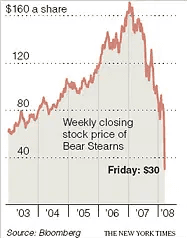
Just three days ago, the head of Bear Stearns, the beleaguered investment bank, sought to assure Wall Street that his firm was safe.But those assurances were blown away in what amounted to a bank run at Bear Stearns, prompting JPMorgan Chase and the Federal Reserve Bank of New York to step in on Friday with a financial rescue package intended to keep the firm afloat.The move underscores the extreme stresses that the credit crisis has imposed on the financial system and raises the once-unthinkable prospect that major Wall Street firms might fail.The developments may only postpone the eventual sale of all or part of Bear Stearns, which has had crippling losses on mortgage-linked investments. To keep the 85-year-old firm solvent, JPMorgan, backed by the New York Fed, extended a secured line of credit that gives Bear Stearns at least 28 days to shore up its finances or, more likely, to find a buyer.News of the bailout ignited fears that other big banks remain vulnerable to the continuing credit crisis, and stocks tumbled in another rocky day for the markets. Financial shares led the way, with shares of Bear Stearns plunging 47 percent. Hours after the rescue was announced, another Wall Street firm, Lehman Brothers, said it had secured a three-year credit line from banks. Its stock fell 15 percent.Policy makers are likely to spend the weekend dealing with the fallout in the financial system, and potential buyers are already circling Bear Stearns.As the Wall Street drama unfolded, Ben S. Bernanke, the Federal Reserve chairman, added fresh warnings Friday about a gathering wave of home foreclosures bearing down on American communities.President Bush, meantime, made his most striking acknowledgment yet of the country’s economic troubles, even as he defended his administration’s responses so far and warned against more drastic steps by the government to intervene.“Today’s events are fast moving,” he said, “but the chairman of the Federal Reserve and the secretary of the Treasury are on top of them and will take the appropriate steps to promote stability in our markets.”The rescue effort began late Thursday evening, when Alan D. Schwartz, Bear Stearns’s chief executive, placed an urgent call to James Dimon, his counterpart at JPMorgan Chase. Mr. Schwartz said Bear Stearns was struggling to finance its day-to-day operations, according to several people briefed on the negotiations, a situation that would threaten its survival.Because JPMorgan settles transactions for Bear Stearns as its main clearing bank, it was in a good position to assess the collateral that Bear Stearns could provide against a loan. But Mr. Dimon insisted on the support of Timothy F. Geithner, president of the New York Fed. Mr. Geithner quickly agreed to the plan.Assisted by Gary Parr, a top investment banker at Lazard specializing in financial companies, Mr. Schwartz and Mr. Dimon spent the night negotiating the deal, which was not sealed until the early hours of Friday.The size and terms of the credit line were not disclosed. JPMorgan will borrow the money from the Fed and lend it to Bear Stearns, and the Fed will ultimately bear the risk of the loan.Meetings between Bear Stearns and prospective suitors have already begun. Interested parties include J. C. Flowers & Company, the private equity investor, and Royal Bank of Scotland, according to people who were briefed on the discussions.The Fed’s intervention highlights the problems regulators face as they contemplate the prospect that investment banks, saddled with toxic securities tied to subprime mortgages, are losing the trust of their lenders and clients — the kiss of death on Wall Street, where confidence has always been the most precious asset of all.Traditionally regulators have helped commercial banks in financial panics, but not investment banks, which do not hold customer deposits. But the 1999 repeal of the Glass-Steagall Act, the Depression-era law that separated investment banks and commercial banks, led to consolidation within the financial industry that has made such distinctions harder to make.“I don’t remember a Fed action aimed at a noncommercial bank; this is the kind of thing you see in this post-regulatory environment,” said Charles Geisst, a Wall Street historian at Manhattan College.The developments represent a devastating blow to Bear Stearns, which has carved a niche by mastering the financial arcana of the mortgage market. But after two of its hedge funds that specialized in the subprime mortgage market collapsed last summer, Bear Stearns’s area of strength became a millstone.In a conference call on Friday, Mr. Schwartz, who succeeded James E. Cayne as chief executive early this year, sounded frustrated as he described the run on Bear Stearns over the previous 24 hours, and raised the possibility that the firm’s days as an independent bank were numbered.“This is a bridge to a more permanent solution and it will allow us to look at strategic alternatives that can run the gamut,” he said. “Investors will be able to see the facts instead of the fiction. We will look for any alternative that serves our customers as well as maximizes shareholder value.”Only days earlier, Mr. Schwartz, a well-connected investment banker who has been at Bear Stearns since the early 1970s, appeared on television to try to calm market fears that the bank was in trouble. Skittish lenders were already calling in loans made to Carlyle Capital, a bond fund sponsored by the Carlyle private equity group, as well as Thornburg Mortgage, a major mortgage firm. Soon the attention spread to Bear Stearns as market players began to question the firm’s ability to finance itself, sending its stock into a tailspin.By late Thursday, Bear Stearns’s top lenders and its hedge fund clients were calling the firm and demanding their cash back, perhaps encouraged by Mr. Schwartz’s comments that the firm’s capital and liquidity were strong.Mr. Schwartz said on Friday that he hoped to find a long-term solution as soon as possible. At its closing price of $30 a share on Friday, Bear Stearns was trading at a gaping discount to its reported book value of $80 a share. Mr. Schwartz said that Bear Stearns, which moved up the reporting of its first-quarter results to this Monday, is still likely to have a result in the range of analyst estimates, suggesting a profit and a slight expansion of its book value, the truest measure of its financial condition.Questions persist, however, concerning the real value of its remaining assets.While Bear Stearns has valuable businesses like its hedge fund servicing and back office unit, as well as aspects of its real estate operations, they are unlikely to command a high price given the current market. But Mr. Dimon, despite having expressed reservations on buying another investment bank, could bid for all or part of Bear Stearns at a discounted price. Bear Stearns might accept his offer if it cannot solicit a competing bid.The troubles at Bear Stearns have come quickly and savagely and hurt some of the putatively smartest money in finance. From Joseph Lewis, the Bermuda-based billionaire who bought $1 billion of Bear Stearns shares last summer, when the stock was trading at $100 and above, to William Miller, the vaunted value investor at Legg Mason, those who have wagered on a turnaround at Bear Stearns are many.As the smallest of the major Wall Street banks, Bear Stearns disdained the big bets that its larger competitors made and shied away from trendy markets like Internet stocks in the 1990s.But as its core mortgage business flourished during the housing boom from 2003 to 2006, Bear Stearns, under the guidance of Mr. Cayne, succumbed to the fervor of the time. Bear Stearns’s stock price soared and hit a high of $171, making Mr. Cayne, who owns 5 percent of Bear Stearns, a billionaire for a brief moment.The demise of the hedge funds began a slow but persistent loss of market confidence in the bank. Such an erosion can be devastating for any investment bank, especially one like Bear Stearns, which has a leverage ratio of over 30 to 1, meaning it borrows more than 30 times the value of its $11 billion equity base.“The public has never fully understood how leveraged these institutions are,” said Samuel L. Hayes, a professor of investment banking at Harvard Business School. “But the market makers understand this inherent risk. This is a run on the bank, just like Long-Term Capital Management, Kidder and Drexel Burnham.”
article
Sell
Sell
133690
Mirae Asset TIGER NASDAQ100 ETF
user
박재훈투영인
·
10 months ago
0
0
Wall Street crisis: Lehman staff tell their stories(15 Sep 2008)
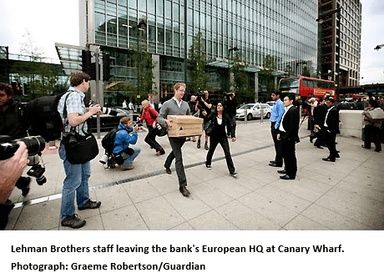
Lehman Brothers employees in London and New York today described how many staff, some in tears, had already cleared their desks at the collapsed investment bank and and left the buildings.Some were swiftly on the phone to headhunters, as other polished up their résumés. In New York, tourists gathered outside Lehman's offices on 7th Avenue to take snaps as shocked employees left the building carrying boxes of personal possessions. Others headed to the company's cafeteria to use up remaining credit on their canteen cards.In London, one member of staff told how some of his colleagues had been in tears as news of the firm's demise had filtered through. Another described how staff were "finishing up", swapping contact details and boxing their belongings before going home.Graduate trainee Jack Reynolds, who had been at the company for just one week, left the bank's European headquarters building in Canary Wharf, London, carrying a Lehman Brothers branded umbrella and rugby ball."My career has been screwed," he said. "No one is happy. Everyone is upset and down but they've just got to get on with it."An internal communication was handed out to members of staff as they entered the building at Canary Wharf this morning. It read: "Our email earlier today provided high-level information regarding recent changes impacting the firm. We will update you as soon as possible on these developments and their impact on the UK business."In the interim, it is important that we do not commit any financial obligations to third parties until the situation is clearer. Accordingly, no trades or other transactions may be entered into by members of staff today without prior clearance from a member of the Europe and Middle East operating committee."We realise this will contribute to the uncertainty in the short term but this is a necessary precaution to protect your interests and those of the firm."Kirsty McCluskey, 32, who worked on Lehman's London trading floor, said her manager had promised her he would process her expenses. "It is terrible. Death. It's like a massive earthquake," she told reporters. "It's final. Everybody is just finishing up. I'll now try to move into another industry."Outside Lehman's worldwide headquarters in Midtown Manhattan this morning, tourists Harry and Jane Saunders were taking pictures of staff as they left the building. "We just got off a transatlantic cruise, we live in Arizona, so we don't see things like this very often. And this is very sad, very sad."They put the blame on President Bush, but said: "You can't expect the Federal Reserve to bail everybody out. We don't have enough money to bail everybody out." They said they felt they would be affected personally by the extraordinary events of the past few days: "Let's put it this way. We just got off a transatlantic cruise, right, and we had two more already lined up. We may cancel."The collapse of Lehman Brothers, which has lost billions of dollars on risky mortgage-backed investments, followed the failure of rescue talks over the weekend. Its US parent subsequently filed for bankruptcy protection in America early today, with administrators being called into its European headquarters in London hours later.In Britain, Lehman employs 4,000 staff in Canary Wharf. It also has an office in High Wycombe, Buckinghamshire, which is a subsidiary called Capstone Mortgage Services.As part of the UK administration, accountancy firm and administrator PricewaterhouseCoopers (PWC) said a number of Lehman group companies remained solvent and would continue to trade. These companies include Lehman Brothers Asset Management (Europe), as well as others which manage property portfolios and loans.Today, Duo Ai, 26, who worked in research, said the atmosphere inside the building at Canary Wharf was one of shock. He said: "A lot of people are very sad. I heard someone was crying. I guess it's understandable if they invested a lot in Lehman stock."We really didn't see this coming. On Friday we were still holding out hope that some bank would buy Lehman. Everyone's understanding is that everyone is gone and everyone is clearing their desks."I couldn't sleep last night but stayed up talking about what was going to happen. The only question that remains is whether we will get this month's pay cheque."John Collins, 40, who works in equity derivatives product control, said he had been told not to come back tomorrow. "People are trying to put a brave face on it but obviously there are some disconsolate people in there who have taken it very badly," he said. "They say the economy is in its worst position since the 1920s. And they could be right. It's only the guys at the top who really know what's happening."In New York, Lehman workers also complained about lack of information. "We're not trading and we're just kind of waiting to hear," said one worker in fixed income. "We have gone straight to acceptance. We have gone through the stages of grief - there is not much you can do about it. People are getting their résumés together but it is not the best time to be looking for a job in financial services. But you do what you have to do. It was quick. It surprised me. But that is the pace of finance these days. Things can go that quickly they are so very highly leveraged."My opinion is that Dick Fuld probably held on too long - if something had happened a few months ago, we could probably have survived or we could have been acquired instead of going bankrupt."But it was "surprisingly calm," said one technology worker on the trading floors."People are kind of joking. Somebody said he was hoping he would get back a suit that somebody borrowed and never returned."It is obviously not a good place to be. But there is no crying or anything like that. Everybody is kind of being really strong about it. It has been getting worse and worse for so many months. I think we had a lot of hope over the weekend but by Sunday, people were saying, it looks like it is game over. Kind of a slow realisation, you know."We have had nothing at all about when they will put us in the picture. If you didn't know what was going on, and you went on some of the trading floors, you wouldn't see anything unusual, guys are standing, guys are talking, guys are at their computers."Most had turned up for work, said a Lehman IT worker. "People are in neutral and they are clearing things out. There is a bit of desk clearing going on; there has been desk clearing going since the weekend. There is some disbelief at the speed at which this happened."A trader, asked what his plans were, replied: "What am I going to do? Try and find a job. I am not at all confident in the current markets but you do what you can."
article
Strong Sell
Strong Sell
133690
Mirae Asset TIGER NASDAQ100 ETF
user
박재훈투영인
·
10 months ago
0
0
3 Photos That Help Explain the Frenzy Over Alibaba's IPO(2014년 9월 18일)
If you live in China, or perhaps Russia, or are part of the Chinese diaspora, you already know how big a deal Alibaba Group is. And if you're one of the investors clamoring for a piece — any piece — of the giant e-commerce company, there's no doubt you're sold on its prospects.For others, though, who are still trying to wrap their brains around how a Chinese company founded in an apartment — not a Silicon Valley garage — could pull off the world's largest initial public offering, here's some visual help.No, that's not the control room at NORAD. It's a photo from last year of Alibaba's employees watching a live broadcast of transactions on Singles' Day, which celebrates those without a significant other. The day in November has become a huge occasion for e-commerce companies to deluge the Internet with steep discounts.Last year, Alibaba's two main platforms — Taobao Marketplace and Tmall — had sales of about $5.8 billion during the 24-hour period. For some context, sales on Cyber Monday, the busiest online shopping day in the U.S., hit a record of about $2 billion in 2013.Of course, what would you expect, given that the number of Internet users in China — 632 million, according to government data — is about double the total population of the U.S. Meanwhile, a McKinsey & Co. report sees China's e-tailing market growing to as much as $395 billion next year, which is triple the amount in 2011."Because Chinese retail is coming of age in the midst of the digital revolution, its evolution may follow a different — and faster — trajectory than what has occurred in other countries," the report said.Singles' Day also demonstrated Alibaba's logistical prowess: The company said it processed 254 million orders within 24 hours and handled 156 million packages, compared with its daily average of almost 17 million, according to a U.S. Securities and Exchange Commission filing.Pictured here are workers packaging yarn at an office in Qinghe county, about 230 miles from Beijing. The significance?It's rural regions like this that are playing a big role in the growth of Alibaba's platforms. About 4.5 million sellers, or slightly more than half of those hawking their goods on the company's Chinese retail marketplaces, were located outside of China's major cities (also known as tier 1 and 2 cities), according to Alibaba's filing. About 173 million buyers, or 62 percent of those actively making purchases, also reside outside of the big cities. And as more rural residents go digital thanks to lower-priced smartphones from companies such as Xiaomi, Alibaba stands to benefit.As Bloomberg News reporter Lulu Yilun Chen wrote last year, Alibaba has helped people such as Liu Yuguo rake in more than $1.6 million in just two years by selling yarn on Taobao. That enabled the former farmer with a seventh-grade education to buy a four-story office and a BMW X6 sports utility vehicle.In his letter to investors, Alibaba founder Jack Ma said the company's mission is "to make it easy to do business anywhere." And apparently, selling anything, whether that's an "advanced outdoor energy efficiency hot dog trailer" (pictured here, starting at $1,280), a life-size Vladimir Putin wax figure or cherries harvested in Utah.In its SEC filing, Alibaba said more than 170 tons of cherries grown by farmers in the U.S. were sold to Chinese consumers last year through Tmall, in partnership with the Agricultural Trade Office in Shanghai and the U.S. Department of Agriculture. In boasting about its logistical abilities, the company said the cherries were delivered from the tree to the table within 72 hours. Alibaba also cited Chilean blueberries, Alaskan king crab and lobsters from Canada as examples of overseas perishables it has made available to Chinese consumers.It's this dizzying array of products that helps Alibaba reach users outside of China. And with the company focused on brokering transactions into and out of the country, that promises to "enable a new age of border-hopping commerce that bypasses middlemen," Bloomberg Businessweek's Brad Stone wrote last month. Add to that the $21.8 billion Alibaba raised in its IPO, and you have a company capable of becoming the first truly global online marketplace.
article
Sell
Sell
371160
TIGER China Hang Seng TECH
+2
user
박재훈투영인
·
10 months ago
0
0
IPO Frenzy: A bubble or the right strategy to enter a booming market?(7 Oct 2024)
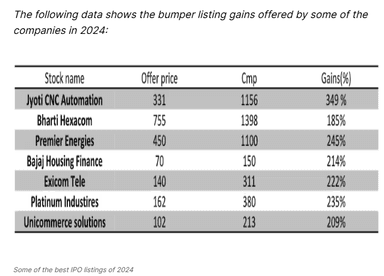
The Indian stock market has been on fire recently, with September emerging as one of the busiest months for initial public offerings (IPOs) in the past 14 years. According to the data released by the Reserve Bank of India (RBI) on September 20, IPO activity in the country has reached an all-time high, highlighting a significant resurgence of interest in public listings. This surge is not limited to large companies; it encompasses both the mainboard and the small and medium enterprise (SME) segments, showing a diverse appetite for investment opportunities across different market sectors.September alone witnessed over 28 companies making their debut on Dalal Street, split between the mainboard and the SME segments. This number is remarkable, as such an IPO surge has not been seen in over a decade. The sudden resurgence indicates a renewed sense of confidence and eagerness among both companies and investors to participate in the capital markets. It seems that investors are increasingly seeing IPOs as a strategic entry point into a market that is scaling new highs, despite the risks associated with such investments.On the global front, India’s recent IPO activity stands out impressively. The RBI report highlights that India accounted for the highest number of public listings worldwide, capturing a striking 27% share of all IPOs during the first half of the 2023-24 fiscal year.The Role of SME IPOs in driving the surgeThe surge in IPOs has been significantly fueled by the SME segment. The massive oversubscriptions of SME IPOs have attracted considerable attention, turning them into a focal point of the ongoing IPO frenzy. SMEs are increasingly capitalising on investor enthusiasm, with many small businesses using public listings as a way to secure capital for expansion and growth. The enthusiasm seen in the SME space speaks volumes about the expanding scope of opportunities available to retail and institutional investors alike.However, the enthusiasm is not without its risks. The RBI’s report pointed out a potentially concerning trend wherein promoters, particularly in the SME segment, have been using favourable conditions in the primary market to offload their stakes at inflated prices. While this may represent a smart exit strategy for existing shareholders, it raises questions about the long-term value for new investors, especially when the market is already at elevated levels. The risk of overvaluation looms large, with some IPOs potentially being priced higher than what fundamentals would suggest, leading to an overheated market scenario.IPO Strategy: A Double-Edged Sword for InvestorsThe current IPO frenzy is both an opportunity and a cautionary tale for investors. On one hand, IPOs provide a unique chance to get in on the ground floor of promising companies and participate in the economic growth of the country. On the other hand, the possibility of overvaluation and promoters cashing out at high prices can lead to significant losses for new investors if the broader market experiences a correction.For investors considering entering through IPOs, it is critical to evaluate the fundamentals of the companies going public and not get swept up in the hype. The broader market may be at a high, but a sound strategy—focused on due diligence, risk assessment, and a long-term perspective—can help navigate the opportunities and pitfalls of this burgeoning IPO landscape.
article
Sell
Sell
453870
TIGER India Nifty 50
+2
user
박재훈투영인
·
10 months ago
0
0
Investor-Sentiment Surveys Indicate Bullishness Is High(June 18, 2001)
Investors have feelings, too, and lately, some analysts fear, they may have been letting those feelings run a little too wild. One of the more arcane stock indicators out there is called investor sentiment -- essentially, how giddy or gloomy investors are feeling.Feelings are just one of many things influencing stock prices, of course. But they do affect people's willingness to invest money, and that means they have a concrete aspect to them. Investors' expectations help determine whether they put money into stocks or hold it out of the market, and that, in turn, can affect demand for stocks. It works like this. When investors are feeling hopeful about stocks, they tend to take money out of cash reserves and put it into the market. The more hopeful they get, the more they then put into stocks and the more stocks rise. It can be a circular process. Eventually, the available cash dwindles, and the bullishness hits its limit. Something happens to make people worry -- bad economic news, perhaps, or a corporate-earnings problem. Then bullishness starts to decline, people take money out of stocks and rebuild cash reserves, and stocks get knocked down. Finally, cash and bearish feelings get to an extreme, the bad news blows over, and the upswing starts again. According to this theory, the best time to buy is when bullishness is just beginning to grow, because that is when money is moving into stocks. The riskiest time to buy is when bullishness is high and just beginning to decline. That's when people are overly optimistic, and money is starting to come out. And that, alas, is the way the market looks to some people right now. A variety of measures of investor sentiment, tracking the feelings and actions of individual investors, professional money managers, newsletter writers, Wall Street stock strategists, futures traders, options traders and others, show bullishness at high levels right now. In most cases, the bullishness has just begun turning down from a high. The surveys "suggest that people are way too bullish, and that people will have to get a lot more bearish before stocks go much higher," says Jason Trennert, an economist at the New York market-analysis firm International Strategy & Investment, which has been surveying 50 professional money-management firms since 1994. ISI's survey shows investors recently have been at a far-higher level of bullishness than at any time since the survey began, which is worrisome since it is hard to imagine the optimism going much higher.The market certainly has been showing signs of fatigue lately. Amid growing nervousness about the prospects for corporate earnings, the Dow Jones Industrial Average fell 3.22%, or 353.36 points, last week, to 10623.64, including a drop of 0.62%, or 66.49 points, on Friday. The Nasdaq Composite Index, which had been leading the recent gains, suffered its worst one-week percentage decline of the year, falling 8.43%, or 186.67 points, to finish the week at 2028.43. The Nasdaq slide left the index down 12% since its recent high on May 22, although it is still up 24% since April 4. The broad Standard & Poor's 500-stock index fell 4%, or 50.6 points, for the week to 1214.36. Some analysts see current market sentiment as a decidedly negative factor. In this view, too many people haven't understood how weak the once-beloved technology stocks are. As those people become disgruntled, they will sell, driving the stocks, and the overall market, down to new lows, the skeptics say. But the prevalent view is that the current exuberance may just put a limit on the market's ability to gain, rather than pushing stocks to new lows. Ned Davis Research in Venice, Fla., has created a composite sentiment indicator based on a wide variety of other sentiment indicators, involving individual investors, mutual-fund investors, investment advisers and options and futures traders. Ned Davis's measure, dubbed the Crowd Sentiment Poll, got to a level of 67.1% bullish on May 22, the day the Nasdaq hit its recent high. It has been slipping since then. Because other market factors are more positive, the firm sees that as a sign of a pause in the recent gains, rather than a new bear market. "It is consistent with a pullback in an ongoing uptrend," says Tim Hayes, Ned Davis's global stock strategist. One of the more-offbeat sentiment indicators is a survey done by Richard Bernstein, chief quantitative strategist at Merrill Lynch, who tracks the recommendations of 15 prominent Wall Street investment strategists. As of late May, the strategists were recommending that clients keep an average of about 69.6% of their funds in stocks, the highest level since 1985, when the data began to be compiled. "We keep having to redraw the chart because it keeps going up," Mr. Bernstein says. The extreme bullishness probably bodes ill for stocks, he adds, since it isn't likely to go much higher. Mr. Bernstein acknowledges that he raised his own recommended stock holding in April, although only to 60%. He thinks the overall market isn't likely to fall back to April lows, although he thinks technology stocks will. But some analysts think sentiment and money-flow data remain bullish. Jeff Rubin, research director at Birinyi Associates, says he has for years compiled anecdotal evidence of investor sentiment from media reports. His recent readings tell him that investors still are nervous about the market, far from the exuberant bullishness that was prevalent early last year. Birinyi Associates also tracks money moving into and out of stocks, and finds reason for optimism. Birinyi sees signs that on days when stocks have declined in recent weeks, some professional investors have continued to move in and gradually accumulate positions on the lows. That, Mr. Rubin thinks, puts a limit on declines and indicates that stocks could be poised to recover. Some analysts try to track actual cash levels, to determine not just what people feel but what they are doing about it. That is harder to do, since people put money into money-market funds for many reasons, not just to park it before they put it into stocks. According to Ned Davis, cash holdings now make up 21% of total household financial assets, up from a low of about 18% early last year. That rise no doubt came partly because people held money out of the stock market, but also no doubt because the value of people's stock holdings has fallen since early 2000, while the value of a dollar hasn't. Ned Davis notes that the average cash holding since 1952 is just under 29%, meaning that people still have less money than usual in cash. Every week, ISI asks 50 money managers how much of their available cash reserves they have in stocks -- as opposed to holding it on the sidelines in cash. Most stock portfolio managers are required to keep most of their money invested in stocks; the question is what they do with the 5% to 10% of assets they are allowed to keep in cash. As of June 12, they had 65% of that available cash invested in stocks, a high level. That left them relatively little still to move into the market.
article
Sell
Sell
Event
user
박재훈투영인
·
10 months ago
0
0
WorldCom's financial bomb(June 26, 2002)
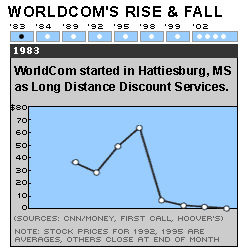
NEW YORK (CNN/Money) - Confidence in Corporate America hit new lows Wednesday as President Bush, Congress and other federal regulators vowed to investigate WorldCom while securities analysts forecast bankruptcy for the latest firm to fool investors with inflated profits. WorldCom, which will downwardly restate financial results in one of the biggest accounting scandals in history, joins Enron, Global Crossing and Tyco International among the tarnished success stories of the 1990s. graphic graphic Save a link to this article and return to it at www.savethis.comSave a link to this article and return to it at www.savethis.com Email a link to this articleEmail a link to this article Printer-friendly version of this articlePrinter-friendly version of this article View a list of the most popular articles on our siteView a list of the most popular articles on our site graphic graphic "No one blow is going to be terminal," said Pete Peterson, the chairman of Blackstone Group "But this is another very serious one. All this does is add to the increasing loss of confidence in our systems." Peterson leads a group of investors that includes the heads of TIAA-CREF, the big pension fund and Vanguard, the mutual fund company, that are drawing up corporate governance recommendations. Bush Wednesday promised a full investigation into WorldCom's accounting problems following word that the No 2 long-distance telephone provider improperly booked $3.8 billion over the past five quarters. The mis-accounting made earnings look better than they really were. "We will fully investigate and hold all people accountable for misleading not only shareholders but employees as well," said Bush, who called the news "outrageous." "Those entrusted with shareholders' money must strive for the highest of standards." Hours later, the SEC filed a civil lawsuit against WorldCom, charging the company with fraud. "We're seeking orders that will prevent any dissipation of assets or payouts to senior corporate officers past or present, and preventing any destruction of documents," SEC chairman Harvey Pitt said in New York. The Federal Communications Commission is also taking some steps in the scandal. FCC Chairman Michael Powell said Wednesday that he was "deeply concerned" by the WorldCom developments and their impact on the telecom industry. Powell said he will travel to New York on Friday and meet with a variety of telephone industry officials, analysts and debt-rating agencies to assess the challenges facing industry. "We are closely monitoring the situation and are doing everything possible to ensure and protect both the stability of the telecommunications network and the quality of service to consumers," Powell said in a statement. Investors Wednesday could not trade WorldCom shares, which were halted after falling more than 98 percent from their all-time high through Tuesday. But the overall stock market ended little changed, recovering from an earlier tumble. The Justice Department is also looking into WorldCom, a spokesman said at a midday briefing, joining a Congressional panel, which vowed an inquiry of its own. Memories of Enron The latest accounting misdeeds unnerved investors leery about the accuracy of corporate profits after the collapse of Enron Corp., which filed the biggest bankruptcy in the United States last December. Arthur Andersen LLP, found guilty earlier this month of obstructing justice in the Enron case, signed off on WorldCom's books. "Our senior management team is shocked by these discoveries," WorldCom CEO John Sidgmore, who was appointed in April, said in a statement. "We are committed to operating WorldCom in accordance with the highest ethical standards." The news late Tuesday from WorldCom prompted industry analysts to say the heavily indebted long-distance provider might file for bankruptcy protection from creditors. WorldCom is looking for about $4 billion in financing but some of its main bank lenders, including Bank of America, J.P. Morgan and Citigroup, are refusing to loan them any more, banking sources told CNN/Money. "They will have to file bankruptcy in a matter of days," a person familiar with the situation said. But other bankers close to the situation said it was too early to say whether WorldCom will file for bankruptcy soon. graphic Related stories The death of confidence The last straw Analysts punish telecoms In addition to describing improper accounting, WorldCom said it would cut 17,000 jobs, about a quarter of its work force, and fired Chief Financial Officer Scott Sullivan. David Myers, senior vice president and controller, resigned. The company, based in Clinton, Miss., said an internal audit showed that expenses of $3.1 billion for 2001 and nearly $800 million for the first quarter of 2002 were improperly accounted for. WorldCom said restating the expenses to account for their true costs would cut reported cash flow -- or earnings before interest, taxes, depreciation and other items -- for last year and the first quarter of 2002. While CEO Sidgmore said the company remains "viable and committed to a long-term future,"Adam Quinton, who covers WorldCom for Merrill Lynch, said the developments bring the company closer to bankruptcy. "This only adds to investor wariness," said Quinton, who advises investors to sell shares. Nervous times WorldCom's revelations may deter already reluctant customers from buying communications services. And its access to existing lines of credit may also dry up as banks demand repayment. "The development brings into serious question the company's ability to close on a new bank deal and it raises the likelihood the company will file for Chapter 11 [bankruptcy protection]," Marc Crossman, who follows the company for J.P. Morgan, wrote in a note to clients Wednesday morning. But one banker close to the situation said that WorldCom has $2 billion in cash that they have yet to burn through, making bankruptcy unlikely. "This is vastly different from Enron," the person said. "The $2 billion will last them several months." The SEC said WorldCom had committed "accounting improprieties of unprecedented magnitude" -- proof, it said, of the need for reform in the regulation of corporate accounting. To finance that reform, the House voted overwhelmingly Wednesday to authorize a 77 percent boost in the SEC's budget, raising it to $776 million for the fiscal year beginning Oct. 1. Elsewhere, the chairman of the House Energy and Commerce Committee said he ordered a separate WorldCom probe. "Clearly, it was an orchestrated effort to mislead investors and regulators, and I am determined to get to the bottom of it," said committee chairman Billy Tauzin, R-La. The accounting mishap comes during a tough time for WorldCom, which could face Nasdaq delisting if its share price remains below $1. The company's market value had tumbled to $2.7 billion at the close of trading Tuesday, from about $125 billion in mid-1999. Salomon Smith Barney Telecom Analyst Jack Grubman -- who had been perhaps the most bullish analyst on WorldCom -- cut his rating to "underperform" just a day before the company's announcement Tuesday. WorldCom said it asked its new auditors, KPMG LLP, to undertake a comprehensive audit of the company's financial statements for 2001 and 2002. The company will reissue unaudited financial statements for 2001 and for the first quarter of 2002 as soon as it can. John Hodulik, who covers WorldCom for UBS Warburg, said the restatement should reduce WorldCom Inc.'s reported 2001 "cash flow" by 32.5 percent to $6.3 billion and first quarter results by 36.9 percent to $797 million. "We are unable to provide a realistic price target until we have reliable financials," said Hodulik, who rates the company's stock a "hold." Click here for a look at what other analysts are saying about WorldCom. Selling assets In addition to the 17,000 job cuts, the company said it is selling a series of non-core businesses, part of a plan to save $2 billion. WorldCom stock began falling in late 1999 as businesses slashed spending on telecom services and equipment. A series of debt downgrades this year have raised borrowing costs for WorldCom, which is struggling with about $32 billion in debt. WorldCom said it has no debt maturing during the next two quarters. Former WorldCom CEO Bernie Ebbers resigned in April amid questions about $366 million in personal loans from the company and a federal probe of its accounting practices. WorldCom, whose shares once traded near $64 in 1999, tumbled to 21 cents in before-hours trading, down from Tuesday's regular-hours close of 83 cents. Top of page
article
Sell
Sell
133690
Mirae Asset TIGER NASDAQ100 ETF
+2
Economy & Strategy
user
셀스마트 판다
·
5 months ago
0
0
How Does the S&P 500 React After the ISM Services PMI Release?
The U.S. ISM Services PMI for June is scheduled for release on July 3 at 10 a.m. ET. Market consensus expects a slight rebound to 50.5, up from 49.9 in May — a return above the neutral 50 threshold would indicate an expansion in the services sector.In May, the index dipped below 50 for the first time since June 2024, reflecting contraction. New orders fell sharply to 46.4, signaling weak demand. However, the prices index surged to 68.7, suggesting ongoing inflationary pressure, while employment barely held expansion at 50.7.The upcoming data will likely influence both Fed policy expectations and market sentiment. A reading above expectations may signal resilience in services, while a downside surprise could revive concerns about economic slowdown and shift investor preference toward defensive assets.S&P 500 Performance After ISM Surprises (2008–present)After an upside surprise (92 events)+0.50% average return over 2 weeks+0.55% average return over 1 monthAfter a downside surprise (113 events):+0.12% average return over 2 weeks+0.63% average return over 1 monthHistorical data suggests that ISM Services PMI surprises have limited short-term impact on equity returns. While direct correlation remains weak, there is potential for indirect effects via shifts in interest rate outlooks and investor sentiment over a one-month horizon.[Compliance Note]All posts by Sellsmart are for informational purposes only. Final investment decisions should be made with careful judgment and at the investor’s own risk.The content of this post may be inaccurate, and any profits or losses resulting from trades are solely the responsibility of the investor.Core16 may hold positions in the stocks mentioned in this post and may buy or sell them at any time.
article
Neutral
Neutral
SPX
S&P500
user
셀스마트 판다
·
8 months ago
2
0
All That Glitters: Is $3,700 Gold a Reality by Year-End? (Apr 17, 2025)
Gold futures have once again hit a fresh all-time high, fueling speculation that prices could rally to $3,700 per ounce by year-end. On April 15, June gold futures closed at $3,240.4, marking a 35% increase year-over-year. In response, Goldman Sachs raised its year-end price target from $3,300 to $3,700, citing mounting macro risks and structural tailwinds.What’s Driving the Rally?The current surge in gold is attributed to three overlapping catalysts:Escalating geopolitical and trade uncertainty stemming from the Trump administration’s intensified protectionist stance. Some global banks have reportedly relocated gold holdings from London to New York, underscoring a shift toward physical asset security.A weaker U.S. dollar and growing concerns over fiscal deficits are boosting gold's appeal as a hedge against currency debasement.Sustained demand from central banks—notably China—and strong ETF inflows are reinforcing the structural bull case.The People’s Bank of China has increased its gold reserves for five consecutive months, now holding 2,290 tonnes, while emerging-market central banks such as those in Poland, Turkey, and the Czech Republic have also expanded their holdings. Bloomberg analysts described this as a potential “modern gold standard revival.”While UBS flagged short-term overheating and psychological resistance near current levels, it acknowledged that the combination of falling interest rates, a weakening dollar, and geopolitical risk continues to support a longer-term structural uptrend.[Compliance Note]All posts by Sellsmart are for informational purposes only. Final investment decisions should be made with careful judgment and at the investor’s own risk.The content of this post may be inaccurate, and any profits or losses resulting from trades are solely the responsibility of the investor.Core16 may hold positions in the stocks mentioned in this post and may buy or sell them at any time.
article
Sell
Sell
GLD
SPDR Gold Trust
user
박재훈투영인
·
8 months ago
1
0
Lessons from the Tariff Tantrum: What the Market Just Told the White House (Apr 11, 2025)

The past week offered a sobering reminder: markets still hold veto power.Soaring bond yields on Tuesday night triggered a rare wave of concern—even among those previously dismissive of a financial crisis scenario. The sudden spike in long-term yields appeared to spook the White House into delaying its tariff policy by 90 days.According to The New York Times, insiders revealed that the sharp rise in Treasury yields and broader market chaos pushed President Trump to announce a temporary suspension of retaliatory tariffs on most nations.“Economic turmoil, especially the surge in Treasury yields, caused the President to backtrack on Wednesday afternoon,” said four people with direct knowledge of the decision.What likely drove the bond sell-off? Leverage unwinding, liquidity runs, and perhaps even foreign governments hitting the sell button. Regardless of the cause, the combination of equity losses, rising yields, slowing growth, and inflation fears forced the administration’s hand.The equity market has responded with violent swings:S&P 500 returns over the past six sessions include: -4.8%, -6.0%, +9.5%, -3.5%.Wednesday marked one of the top 10 best days for the S&P 500 since 1928, but the optimism didn’t last.This is not normal volatility. This is structural tension.Bond Market Strikes FirstThe yield surge was not just a market move—it was a message. The fixed income market essentially checked the White House, forcing a rare policy reversal.And yet, the core risk hasn’t dissipated. Stocks remain fragile. Bond yields are still climbing. The U.S. dollar continues to weaken. The tariff regime, even with the delay, remains historically aggressive.The Wall Street Journal reported:“Trump told advisors he was willing to accept ‘pain.’ He acknowledged tariffs could cause a recession but said he wanted to avoid one if possible.”That’s a chilling calculus: accept short-term economic damage for perceived long-term leverage. It also raises the odds of a policy-induced downturn.Bear Market… Or Close Enough?Technically, the S&P 500 has not entered a bear market, falling 18.9% from peak—shy of the 20% threshold. But the market has seen similar near-bear drawdowns before:1976–1978: -19.4%1990: -19.9%1998: -19.3%2011: -19.4%2018: -19.8%In reality, the 1% difference is only relevant to historians, not investors.Markets price in future risk. In 2020, stocks rallied while millions lost jobs. The market looked ahead—and was right. This time could be no different: the market may fall before the recession hits, and rebound while the economy is still contracting.[Compliance Note]All posts by Sellsmart are for informational purposes only. Final investment decisions should be made with careful judgment and at the investor’s own risk.The content of this post may be inaccurate, and any profits or losses resulting from trades are solely the responsibility of the investor.Core16 may hold positions in the stocks mentioned in this post and may buy or sell them at any time.
article
Neutral
Neutral
NONE
No Relevant Stock
user
셀스마트 밴더
·
8 months ago
0
0
China Says “We Will Fight to the End” — U.S.–China Tariff War Enters Long-Term Phase (Apr 12, 2025)
The U.S.–China tariff confrontation has entered a new structural phase. Following U.S. President Donald Trump’s decision to raise tariffs on Chinese goods to as high as 145%, China responded on April 12 by imposing retaliatory tariffs of 125% on U.S. imports. With nearly all traded goods now subject to high reciprocal tariffs, analysts warn that bilateral trade has effectively stalled.China’s Ministry of Finance condemned the U.S. actions as "unilateral bullying" that violates international trade norms, hinting at a strategic shift away from tit-for-tat escalation. UBS noted that Beijing’s messaging reflects a recognition that continued tariff escalation yields diminishing returns, given the near-total collapse of trade flows.For the first time, President Xi Jinping addressed the trade conflict publicly, stating during a summit with the Spanish Prime Minister that “China has never depended on the favors of others” and is “ready to fight against oppression.” The rhetoric signals that Beijing is preparing for a protracted standoff. China is also strengthening diplomatic ties, planning a Southeast Asia tour this month and resuming electric vehicle price negotiations with the EU—moves interpreted as part of a multilateral coalition-building effort that excludes the U.S.Meanwhile, the World Trade Organization (WTO) warned that the ongoing trade war could cut U.S.–China trade volumes by up to 80%. In addition to tariffs, non-tariff retaliation has already begun, including restrictions on American films and delays in student visas—indicating that the conflict is spilling over into broader economic and cultural arenas.[Compliance Note]All posts by Sellsmart are for informational purposes only. Final investment decisions should be made with careful judgment and at the investor’s own risk.The content of this post may be inaccurate, and any profits or losses resulting from trades are solely the responsibility of the investor.Core16 may hold positions in the stocks mentioned in this post and may buy or sell them at any time.
article
Strong Sell
Strong Sell
NONE
No Relevant Stock
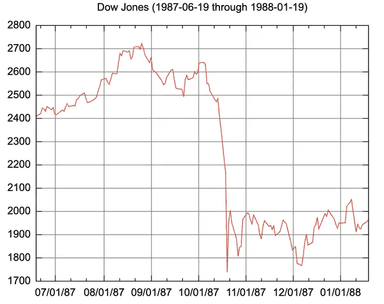
user
박재훈투영인
·
8 months ago
0
0
Is the Worst Over? Why the U.S. Market May Still Struggle (Apr 9, 2025)
Investors are asking the same question on repeat—like a child in the backseat:“Are we there yet?”After one of the sharpest drawdowns in recent history, the S&P 500 briefly slipped into bear market territory on Monday, down more than 20% from its February intraday peak. So, is this the time to buy?It may sound naïve. Trump’s aggressive tariffs are hitting the economy hard and escalating fears of a global recession. Perhaps more damaging than the tariffs themselves is the erosion of confidence in U.S. policymaking—with levies on uninhabited islands and inconsistently applied reciprocity, investors are losing trust in the system. In an environment ruled by fear, equity appetite disappears.Some contrarian investors are taking notice. But is fear truly peaking? And just as important—what could actually trigger a rebound?Sentiment Is CrackingThree weeks ago, I laid out a framework to evaluate whether the market was approaching a bottom. Some indicators were flashing “buy” at the time, but I remained cautious. Today, conditions have deteriorated further.A recent (non-scientific) survey from the American Association of Individual Investors showed that bearish sentiment among retail investors is now at its highest since the 2008 bottom—a striking measure of market anxiety.As the banker Nathan Mayer Rothschild once put it:“Buy when there’s blood in the streets—even if it’s your own.”What Could Break the Downtrend?1. Tariff negotiations could shift.Talks are now underway with more than 50 countries. Even minor concessions could be framed as significant progress, potentially serving as justification to reverse tariffs in some cases.2. Other countries may choose not to retaliate.If U.S. trading partners back off and instead offer improved terms, the administration might respond by rolling back tariffs. While China has pushed back strongly, others are still considering their options.3. The Federal Reserve could intervene.In past episodes of market panic, the Fed stepped in by purchasing risk assets like mortgage-backed securities and corporate bonds. A rate cut remains possible as growth slows, but tariff-driven inflation may limit the Fed’s willingness to act aggressively.Moreover, the central bank may avoid bailing out markets from deliberate policy risks, as doing so could undermine its image of independence.A Market Prone to WhiplashMonday brought a real-time test of market sensitivity. A rumor that tariffs might be paused for 90 days triggered a 6% intraday rally—only for stocks to fall again once the White House labeled the report as “fake news.” Even Trump’s subsequent announcement of a 50% tariff hike on China barely moved markets.That tells us two things:Buyers are waiting for any glimmer of relief.Sellers may already be exhausted.The market could be set up for a bounce, even if a sustained recovery is still out of reach.Don’t Mistake a Rally for a RecoverySharp, short-term rallies are common during periods of fear. Historically, after back-to-back major down days, equities often post gains over the following month.But bear markets are often defined by powerful, unsustainable rallies. One example: the 27% rally in late 2008, which eventually gave way to another leg down before the true bottom in March 2009.Without a catalyst, equities tend to drift lower until a recession either begins or is clearly avoided. A durable recovery needs something that signals recession risk is off the table.What's Next?As earnings season kicks off, CEOs may issue more direct warnings about the damage tariffs are causing—potentially triggering another wave of selling.That said, a significant amount of bad news may already be priced in. More risk-tolerant investors may begin re-entering the market cautiously, while still acknowledging that stocks could fall further if tariffs hold and recession fears intensify.[Compliance Note]All posts by Sellsmart are for informational purposes only. Final investment decisions should be made with careful judgment and at the investor’s own risk.The content of this post may be inaccurate, and any profits or losses resulting from trades are solely the responsibility of the investor.Core16 may hold positions in the stocks mentioned in this post and may buy or sell them at any time.
article
Sell
Sell
SPX
S&P500
user
셀스마트 판다
·
8 months ago
0
0
Could This Be the Worst 3-Day Selloff Since Black Monday? (Apr 7, 2025)
Markets Echo 1987 as S&P Futures Drop Sharply on Tariff Shock and Growth FearsThe S&P 500 futures tumbled more than 3% on Monday (Apr 7), deepening a week-long selloff. If the decline continues, it could mark the worst 3-day loss for U.S. equities since Black Monday in 1987.While history doesn’t repeat itself, it often rhymes — and what’s unfolding now draws eerie parallels to the market crash of October 1987.On October 19, 1987, the Dow Jones Industrial Average plummeted 22.6% in a single day, wiping out over $500 billion in market value in the U.S. alone. This event, now infamous as Black Monday, triggered a global cascade of losses: London’s FTSE 100 dropped 11%, Australia’s market fell over 40% in a month, and Hong Kong’s Hang Seng Index lost nearly half its value within a week.The root causes were layered: a long bull run since 1982 had led to overvaluation, compounded by rising interest rates, growing trade deficits, and mounting anxiety. The immediate trigger? An automated hedging strategy called portfolio insurance, which sold index futures during downturns — a tactic that backfired and amplified the crash. Add to that the rise of program trading and the volatility spike from triple witching just days before, and a full-blown panic unfolded.In 2025, markets are once again flashing red. The Trump administration’s sweeping new tariffs, coupled with global growth fears, have led to steep losses and mounting volatility. S&P 500 futures are down more than 3%, prompting some analysts to warn of a "2025 version of Black Monday."Just like in 1987, today’s turmoil is fueled by a mix of structural fragility and external shocks — in this case, policy uncertainty and concentrated risk exposures.Interestingly, gold prices — often seen as a safe haven — continue to rise despite short-term corrections, supported by central bank buying and geopolitical tensions. Some forecasts suggest gold could test $3,255 per ounce in the coming week. In contrast, silver, with its strong industrial demand link, remains more volatile and less reliable as a defensive asset.[Compliance Note]All posts by Sellsmart are for informational purposes only. Final investment decisions should be made with careful judgment and at the investor’s own risk.The content of this post may be inaccurate, and any profits or losses resulting from trades are solely the responsibility of the investor.Core16 may hold positions in the stocks mentioned in this post and may buy or sell them at any time.
article
Sell
Sell
SPX
S&P500
+1
user
박재훈투영인
·
9 months ago
0
0
Trump’s Claim That Bitcoin Can Solve U.S. National Debt Is Unrealistic (Nov 27, 2024)
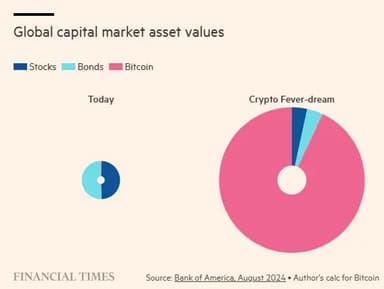
Trump’s Bitcoin Strategy: Rhetoric or Policy Shift?Is Donald Trump’s recent stance on cryptocurrency just political rhetoric, or does it hint at a potential policy direction? As Selena Zito noted in 2016, while the media tends to take Trump’s statements literally, his supporters focus more on his intent. Therefore, his proposal for a "strategic Bitcoin reserve" and using Bitcoin to pay off national debt should not be taken at face value. However, given his recent statements and the current political-economic landscape, the possibility of U.S. government intervention in Bitcoin cannot be completely ruled out.In July, Trump declared at a Bitcoin conference that the U.S. government would not sell its Bitcoin holdings. Then, in September, he proposed creating a sovereign wealth fund to use Bitcoin for debt repayment. The U.S. government currently holds 210,000 BTC, worth $21 billion. To cover $36 trillion in national debt, Bitcoin would need to reach $17.3 million per coin, an unrealistic scenario. However, government-led Bitcoin accumulation remains a possibility.Potential Avenues for U.S. Bitcoin PurchasesTrump could bypass congressional approval and acquire Bitcoin through the Exchange Stabilization Fund (ESF), a $41 billion emergency reserve historically used for financial interventions. If allocated to Bitcoin purchases, it could boost prices significantly.Additionally, Senator Cynthia Lummis has proposed a bill that would revalue the Federal Reserve’s gold holdings from $42.22/oz (book value) to $2,000/oz (market value), allowing the U.S. Treasury to unlock $640 billion. This funding could also be used to acquire Bitcoin, further fueling speculation.If these measures materialize, the U.S. government would emerge as a massive Bitcoin buyer, triggering an unprecedented bull run in crypto markets. However, such government-led accumulation would have profound financial and economic ripple effects. While Bitcoin lacks cash flow and intrinsic utility, its value—like other financial assets—is dictated by institutional trust and adoption. If the U.S. government openly supports Bitcoin, this would mark a transformational shift rather than a speculative trend.Market participants now assign a 1-in-3 probability that Trump’s Bitcoin reserve plan could materialize by April 2025. While policy execution remains uncertain, dismissing this as mere campaign rhetoric is no longer viable.[Compliance Note]All posts by Sellsmart are for informational purposes only. Final investment decisions should be made with careful judgment and at the investor’s own risk.The content of this post may be inaccurate, and any profits or losses resulting from trades are solely the responsibility of the investor.Core16 may hold positions in the stocks mentioned in this post and may buy or sell them at any time.
article
Neutral
Neutral
NONE
No Relevant Stock
user
박재훈투영인
·
9 months ago
0
0
Analyzing 3PROTV’s Influence on Stock Selection and Market Timing (Nov 26, 2023)
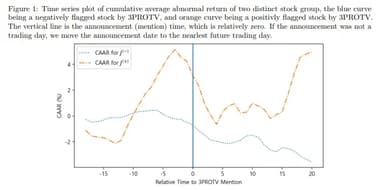
"Information Content of Financial YouTube Channels: A Case Study of 3PROTV and the Korean Stock Market"This study examines the content of 3PROTV, a major Korean financial YouTube channel, and analyzes whether its content provides useful insights for stock selection and market timing.1. Research ObjectivesDetermine whether 3PROTV content conveys positive or negative sentiment about specific stocks.Assess whether 3PROTV content can be used to predict future market returns.2. Research MethodologyCollected transcripts of 3PROTV’s YouTube content from August 2, 2022, to November 28, 2022.Identified mentioned stocks using DataGuide’s Korean company name database.Analyzed sentiment levels using KOSELF (Korean Sentiment Lexicon for Finance).Used the Fama-French 5-Factor Model to estimate expected returns and calculate abnormal returns.Developed a sentiment index to assess its predictive power for future market portfolio returns.Controlled for News Sentiment Index (NSI), short-term interest rates, and liquidity risk factors (PctZero) to validate results.3. Key FindingsStock Selection Insights:Negatively mentioned stocks underperformed after being featured.Positively mentioned stocks performed well before being featured but were often already priced in, limiting their investment value.Investors may overreact to overhyped stocks or face higher volatility.Market Timing Indicator:Changes in 3PROTV sentiment were effective in predicting market returns.The 3PROTV sentiment index successfully predicted the direction of market portfolio returns for the following two days.This predictive power remained significant even after controlling for external factors such as news sentiment, interest rates, and liquidity risk.This suggests that 3PROTV content can provide valuable market timing insights.4. ConclusionThis study shows that 3PROTV content is useful not only for selecting individual stocks but also for determining overall market timing. However, these findings are based on a limited sample period (2022), and negative sentiment appears to have a stronger influence on investor behavior than positive sentiment.[Compliance Note]All posts by Sellsmart are for informational purposes only. Final investment decisions should be made with careful judgment and at the investor’s own risk.The content of this post may be inaccurate, and any profits or losses resulting from trades are solely the responsibility of the investor.Core16 may hold positions in the stocks mentioned in this post and may buy or sell them at any time.
article
Neutral
Neutral
NONE
No Relevant Stock
user
셀스마트 자민
·
9 months ago
0
0
World’s Second-Largest Household Debt: Is Korea’s Monetary Policy Being Hindered? (Mar 17, 2025)
As of the end of last year, South Korea’s household debt-to-GDP ratio stood at 91.7%, ranking it second in the world. Although it has maintained high levels—surpassing 100% for four consecutive years since 2020 (with Canada at 100.6%)—a recent statistical reorganization for the previous year showed a slight decline. Nonetheless, the ratio remains significantly above the emerging market average (46.0%) and the global average (60.3%).The surge in household debt is complicating the Bank of Korea’s monetary policy. According to the BOE’s “Analysis of Household Credit Accumulation Risks and Policy Implications” report, higher household credit ratios are associated with lower GDP growth and an increased likelihood of recession in both the medium and short term. One of the primary reasons the Monetary Policy Board hesitated to cut the benchmark rate last year was concern over high household debt and an overheated real estate market.Recently, policies such as the lifting of land transaction restrictions in designated areas have led to increased real estate activity, particularly in the Seoul region. Experts warn that this uptick in transactions could trigger a sharp rise in household loans in two to three months. If such a surge occurs, the Bank of Korea will face significant pressure when considering future rate cuts.[Compliance Note]All posts by Sellsmart are for informational purposes only. Final investment decisions should be made with careful judgment and at the investor’s own risk.The content of this post may be inaccurate, and any profits or losses resulting from trades are solely the responsibility of the investor.Core16 may hold positions in the stocks mentioned in this post and may buy or sell them at any time.
article
Neutral
Neutral
NONE
No Relevant Stock
user
박재훈투영인
·
9 months ago
0
0
Healthcare Stocks in the Trump Era: What Should Investors Do? (Nov 20, 2024)
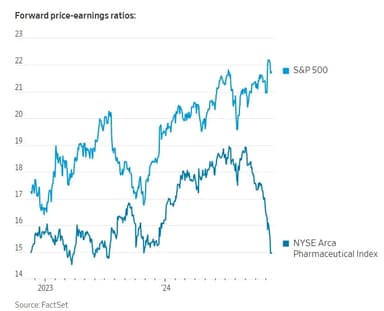
A photo of Robert F. Kennedy Jr. sharing a McDonald’s meal with Donald Trump aboard Trump Force One has sparked early contradictions in the administration’s "Make America Healthy Again" agenda.Donald Trump Jr. shared the image on X, joking, "Making America healthy starts tomorrow." While it's unfair to criticize Kennedy for enjoying fries and cola, the image highlights the paradox of a vaccine-skeptic health advocate dining with a fast-food enthusiast—the very man who once boasted about accelerating COVID-19 vaccine development.Potential Conflicts in Healthcare PolicyKennedy’s anti-corporate stance—particularly against Big Pharma—is more aligned with left-wing populism than Trump’s pro-business policies. While Trump prioritizes tax cuts and tariffs, he has lacked a consistent healthcare reform agenda. His previous attempts to reshape drug pricing and overhaul Obamacare were largely abandoned.Kennedy’s nomination as Secretary of Health and Human Services (HHS) could bring significant regulatory uncertainty for the pharmaceutical industry. His calls for stricter FDA oversight over major drug companies stand in stark contrast to Trump’s deregulatory agenda—a divide already evident within Trump's camp.For instance, Vivek Ramaswamy, a biotech investor and Trump ally, argues that the FDA is overly restrictive and hinders innovation. If Ramaswamy influences Trump’s decisions, it could lead to FDA deregulation, favoring pharmaceutical companies. The key question remains: Will Trump align with Kennedy's aggressive stance on Big Pharma, or will he side with the industry and Wall Street?Market Reactions & Investor ConcernsHealthcare stocks plunged following Kennedy's nominationNYSE Arca Pharmaceutical Index: -5%SPDR S&P Biotech ETF: -10%Big Pharma stocks are already trading at a discountCurrently priced ~35% below the S&P 500Excluding Eli Lilly, the discount rises to 45-50%Uncertainty looms over Kennedy’s actual influenceHHS oversees the FDA, NIH, and CDC, impacting over 80,000 employeesKennedy has advocated caps on drug prices and tighter restrictions on pharmaceutical ads—policies viewed as worst-case scenarios for the industryDespite these concerns, Kennedy may struggle to enact sweeping regulatory changes due to the sheer bureaucratic complexity of the FDA. According to BMO Capital Markets analyst Evan Seigerman, Trump is likely to appoint an industry-friendly FDA chief—just as he did in his first term with former Pfizer board member Scott Gottlieb.Long-Term ImplicationsInvestors should temper expectations for radical healthcare reforms.Trump’s first term showed that healthcare reform is a slow, complex process requiring bipartisan compromise.Kennedy’s opposition to obesity drugs (GLP-1 treatments) could backfire politically, limiting his ability to push through drastic policy changes.Trump may roll back Biden’s Medicare drug pricing negotiation policy, providing relief to pharmaceutical firms.The potential removal of FTC Chair Lina Khan—a critic of Big Pharma—could open the door for more biotech M&A activity.[Compliance Note]All posts by Sellsmart are for informational purposes only. Final investment decisions should be made with careful judgment and at the investor’s own risk.The content of this post may be inaccurate, and any profits or losses resulting from trades are solely the responsibility of the investor.Core16 may hold positions in the stocks mentioned in this post and may buy or sell them at any time.
article
Sell
Sell
453640
KODEX S&P500 Health Care
user
박재훈투영인
·
9 months ago
0
0
Why Is It So Difficult to Sell? It's Because We Don’t Know the Right Time to Re-Enter (Dec 2, 2020)
There are several basic investment principles: diversify your investments, reduce costs, and—perhaps most importantly—stick to your principles even when the market is volatile. That last principle is the hardest to adhere to. Watching your money disappear during market downturns is truly painful, especially when renowned figures predict that the world will collapse amid market crashes.This was the case at the end of February when the U.S. stock market plummeted due to Covid-19. The S&P 500 lost over one-third of its market capitalization in just four weeks—one of the worst situations in history. Many believed that the pandemic would drive the U.S. into a prolonged recession and that the entire industrial sector would collapse, making recovery nearly impossible.In such chaos, holding onto your stocks is a remarkable feat—and the surprising part is that most investors managed to maintain their positions. A recent report from Dalbar, an institution that analyzes mutual fund flows, concluded that “investors’ average preference for stocks did not change even during the Covid period.” Similarly, data from Vanguard Group, which manages assets worth about $6 trillion globally, revealed that only 0.5% of retail clients and retirement accounts were converted to cash between February 19 and May 31 during the crisis.In contrast, during the 2008 global financial crisis, investors engaged in massive sell-offs—a dramatic shift driven by fear. This action was fueled by the prevailing belief that once a crisis begins, the market would never recover.Yet, the market recovered sooner than many expected. Despite no clear signal that the coronavirus had completely vanished, the market began its upward trend by the end of March and recovered to pre-Covid levels by August. As widely known, the stock market started to rebound even eight months before news broke that a vaccine would be developed and administered—a near-accepted truth.The dilemma for investors who sold at the onset of the crisis is now apparent. Since the market bottomed in March, the S&P 500 has surged nearly 60%. Thus, if you had sold your stocks near the high points before the Covid crisis—say, if you had invested $100,000 and then sold after a nearly 50% decline—you would have needed an $83,000 increase just to break even. In contrast, had you stayed in the market, your investment would now be worth $107,000—a return more than 30% higher than if you had sold.The alternative, however, is even more dismal: waiting until the market nears a previous low that may never return. During the financial crisis, even without clear evidence that the financial system would recover, the market began its rebound in March 2009. By October—when all signals had become clear—the market had risen nearly 60%.This is a familiar scenario. Investors who participated in the sell-off during the financial crisis faced similar challenges as those who exited the market during the Covid crisis. Those who re-entered the market during the 2009 recovery, despite concerns of buying at abnormal price levels, ended up earning over three times the returns of those who sold out in panic.There are countless similar examples. Although there are exceptions, history shows that when the market surges from its deepest crisis points, it signals that those investors who stayed in were driving the recovery. Covid-19 is one such example, and investors must continue to adopt this mindset.In other words, during crisis periods, instead of rushing to exit the market, focus on re-entering at the right time. No one can predict the bottom in advance. This means that re-entry can happen either too early or too late. Acting too early is unrealistic. If you feel the urge to sell when the market falls 20%, you likely won’t feel the impulse to buy when it rises 30% or more. The best course of action is to hold your current position.(Source: Washington Post)
article
Neutral
Neutral
NONE
No Relevant Stock
user
박재훈투영인
·
9 months ago
0
0
5 Key Points for Determining the Right Time to Sell Stocks! (Jun 18, 2020)
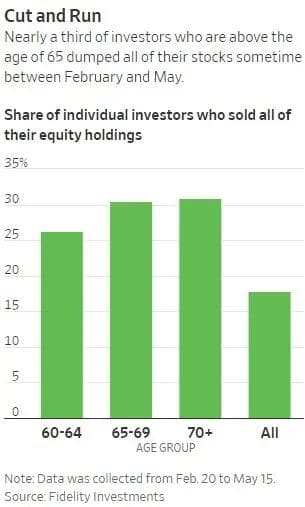
n the stock market, there are always ample reasons to sell. When the “March stock market massacre” occurred, investors wondered whether they should sell because the market seemed likely to fall further. Now, however, as the market appears poised to continue rising both more significantly and more rapidly, many are confused about whether to sell.Investors who sold stocks when the market was near its bear market lows a few months ago often suffer more with their positions than those currently contemplating a sale. Every time you need to make a major change in your asset allocation, the decision is difficult—especially as retirement approaches, when your human capital diminishes and you have less time to endure a painful bear market compared to younger investors.According to Fidelity and the Wall Street Journal, older investors tend to sell more during bear markets than younger ones. Fidelity’s data show that nearly one-third of investors aged 65 and above sold most of their holdings between February and May, and 18% of all customers completely liquidated their positions. I have discussed with many investors who wanted to sell in March; many were concerned about how prolonged downturns might affect their retirement plans. I fully understand why these retirees feel that their happiness is closely tied to their portfolios. The U.S. stock market enjoyed gains for 10 out of 11 years until 2020. This crisis was even likened to a second version of the Great Depression of the 1930s.We are indeed living in frightening times.However, fear and panic are not sufficient or valid reasons to sell. Waiting to sell until the market stabilizes can be a disastrous strategy. Even valuation-based market timing indicators have become almost useless—something anyone who has traded based on fundamentals over the past 20–30 years can attest to.A bear market is one of the worst times to completely overturn your asset allocation, because your decision-making ability is often clouded by emotion.So, when should you sell all or part of your stock holdings?When It’s Time for RebalancingGoing all in or completely exiting your position are among the riskiest moves in investing. While you might occasionally be influenced by luck, in reality you tend to sell before a major bull market begins or buy before a significant bear market sets in. Unless you have a rules-based investment strategy that you can stick to for a lifetime, extreme strategies like these are prone to leading to huge mistakes at the worst possible time.The simplest sell strategy is to adjust your portfolio allocation according to predetermined targets or timelines. For example, after the stock market rose by more than 30% in 2019, some investors sold part of their stock holdings to purchase bonds, cash, or other investments—only to see the stock market surge afterward. Then, after the market fell by over 30% this spring and bonds played a key role in a balanced portfolio, they sold bonds to buy more stocks. Today, those stocks are up 40%—a truly remarkable decision.When Diversification Is NeededI have seen many investors who allocated most of their retirement assets to the stock market instead of bonds. This strategy isn’t for the faint of heart—it works for pure savers who can endure short-term financial pain.When your investment period ends and retirement forces you to start drawing down your assets, a new dynamic comes into play. No one wants to be forced to sell stocks in a depressed bear market just to meet expenses. Even the most risk-tolerant investors eventually feel the need to cover expenses with cash or bonds.A severe bear market might not be the ideal time to seize an investment opportunity, but a significant bull market is never a bad time to re-evaluate your diversified portfolio.When You Realize You’ve Misunderstood the Investment ThemeThis is particularly relevant for those holding concentrated positions in individual stocks or niche ETFs. Every investor should regularly check whether their entry and exit points for an unexplained investment idea are still valid.This is more difficult than it seems. Questions like, “What if I wait until I just break even?” or “What if I sell and it immediately soars?” are common pitfalls that can be seen in losing positions.When You’ve Won Big in the GameIf you’ve been fortunate enough to accumulate an enormous sum—say, 20 to 25 times your expected retirement expenses—and have managed your spending habits well, you might eventually ask yourself, “What’s the point of continuing to take risks?”In a world where risk-free returns are available, such decisions would be trivial. However, the environment where you can simply live off interest from high-quality bonds no longer exists.Yet, if you have sufficient surplus funds to defend against inflation for the rest of your life, you might find that it becomes increasingly difficult to bear the myriad market risks in your portfolio.When You Need to Reassess Your Risk Profile or Adjust for a Change in Investment Period or EnvironmentMost investors believe that portfolio changes should be driven solely by market characteristics. Consider factors like the CAPE ratio, interest rates, Tobin’s Q formula, the A/D line, investor sentiment, and short-, medium-, and long-term performance metrics.Understanding the past and present market conditions can help guide your future decisions, though not every portfolio decision needs to be based solely on market fundamentals.Additionally, consider how your current environment affects your risk tolerance. You might need to reduce risk exposure if you find yourself in a better situation than expected—perhaps you’ve received an unexpected windfall or spent less than anticipated.If you don’t have a clear understanding of your investment goals from the start, building a portfolio becomes nearly impossible.While the market is critically important, you must always base your decisions on your own environment and goals.<Source: awealthofcommonsense>
article
Neutral
Neutral
NONE
No Relevant Stock
user
셀스마트 앤지
·
9 months ago
0
0
Germany Finally Commits to Massive Spending—How Is the Market Reacting? (Mar 5, 2025)
By The Wall Street JournalGermany has announced plans for large-scale spending on defense and infrastructure, marking a major shift from its traditionally tight fiscal policy. This move is expected to stimulate the economy and positively impact the European defense industry. The news sent German stock markets soaring. The DAX index rose 3.4%, while the MDAX index, which focuses on mid-sized companies, surged more than 6%, marking its biggest single-day gain in years. Infrastructure and construction-related firms saw notable gains, with Heidelberg Materials and Bilfinger climbing 18%, while Kion, a forklift manufacturer, surged 20%. Defense and aerospace stocks also saw significant gains. Rheinmetall, Germany’s leading defense contractor, jumped 7.2%, while Airbus, the French aircraft manufacturer, rose 2.4%. Expectations of increased European defense budgets further fueled a rally in the sector. The banking sector also surged, with Deutsche Bank and Commerzbank both gaining over 10%, reflecting the market’s positive sentiment.In the foreign exchange market, the euro strengthened by over 1%, approaching $1.10 against the U.S. dollar.However, the bond market reacted sharply. As the German government prepares to issue more bonds to fund its increased spending, bond prices fell and yields spiked. The 10-year German bond yield rose to 2.8%, marking the biggest single-day increase since 1990.The announcement is also politically significant. Friedrich Merz, the frontrunner for Germany’s next chancellor following last month’s election, called the decision a "historic turning point" for the country. He emphasized that with Europe’s freedom and peace under threat, Germany must take necessary action.Merz and his coalition government plan to create a $530 billion (approximately €500 billion) infrastructure fund and exempt defense spending exceeding 1% of GDP from Germany’s constitutional debt limit rules. The proposal will be officially debated in the German Parliament next week.Deutsche Bank described the policy as "one of the most significant shifts in Germany’s post-war economic history." The bank also raised its euro exchange rate target and signaled a potential upward revision of Germany’s economic growth forecast.Germany’s massive fiscal spending is expected to boost economic growth, with defense and infrastructure sectors among the biggest beneficiaries. However, the stronger euro and rising German bond yields are likely to have far-reaching effects on European financial markets in the coming months.
article
Neutral
Neutral
DB
Deutsche Bank
user
박재훈투영인
·
10 months ago
0
0
Bonds up - a first in weeks(Nov 30, 1999)
Treasury bonds rose Tuesday, their first major gains in two weeks, as the highest yields in a month drew investors into fixed-income securities.    "Yields were near some of their highest levels of the year,� said Bill Hornbarger, fixed-income analyst at A.G. Edwards."You see some people interested in bonds at those levels.�    Just before 3:15 p.m. ET, the price of the benchmark Treasury bond rose 10/32 to 97-27/32. Its yield, which moves inversely to its price, fell to 6.28 percent from 6.30 percent Monday.    The gains came despite two economic reports Tuesday that showed the kind of inflation- suggesting strength that might typically spark a Treasury sell-off. The Conference Board's index of consumer sentiment surged to 135.8 in November from a revised 130.5 reading in October. Separately, the National Association of Purchasing Management said its Chicago prices paid index rose to 70.9 from 65.4.    But David Ging, bond analyst at Donaldson, Lufkin & Jenrette, said Monday�s bond sell-off, which pushed yields to November highs, effectively discounted the day�s news of rising inflation, which erodes a bonds� value.     Bond traders, Ging said, "are really looking at the payrolls data because that�s what (Federal Reserve chief Alan) Greenspan�s looking at.�    That data comes Friday, when the Labor department�s last monthly jobs report of the year is expected to show the kind of labor market tightness that may lead to rising inflation, and help prompt the Federal Reserve to raise interest rates again.    The November unemployment rate is seen holding steady at 4.1 percent, near a 30-year low.    Economists polled by Reuters estimate that non-farm payrolls grew by 226,000 jobs in November.    The Fed tightened credit three times this year in a bid to pre-empt inflation and cool an overheating economy.    Analysts said bonds also got support Tuesday as falling oil prices eased concerns over rising inflation. In New York, light crude for January delivery fell 91 cents to $25.05 a barrel.    "Oil prices have a lot to do with,� A.G. Edwards� Hornbarger said of Tuesday�s gains.    Dollar stuck in the middle    The yen rose Tuesday, nearing last week�s four-year high against the dollar, as traders shrugged off the Japanese government�s second effort in two days to weaken its currency.    Worried about the strong yen�s drag on exports, the Bank of Japan�s latest effort to sell yen for dollars proved ineffective, as traders bet on Japan�s economic recovery by buying yen.    "The market's current belief that U.S. and European monetary officials will not come to the assistance of their Japanese counterparts is rendering Bank of Japan intervention futile,� said Alex Beuzelin, market analyst at Ruesch International.    Just before 3:15 p.m. ET, the yen rose to 101.95 from 102.70 Monday, a 0.73 percent increase in the yen�s value.    Officials fret that a strengthening yen, because it makes exports tougher to sell, may derail the Asian nation's fragile economic recovery. Yen strength hurt Japanese stock market�s, which were pulled down by major exporters like Sony Corp. and Fujitsu Ltd. But the yen continues to strengthen as money floods into Japanese stocks, which must be bought in local currency.    The euro, meanwhile, weakened against the dollar, keeping near lifetime lows versus the U.S. currency    Just before 3:15 p.m. ET, it cost $1.0085 to buy one euro compared with $1.0100 Monday, a 0.15 percent drop in the euro�s value.    Analysts recently have come to blame the slide of the euro, which has lost about 16 percent of its value in its 11-month lifespan, on uncertainty over the European Central Bank�s policy stance.    "The ECB main challenge this week is to give the markets a clear message that it does not favor a precipitous decline in the euro,� Donaldson, Lufkin & Jenrette said in a note to clients Tuesday. "In our view, any further weakening of the euro below parity (with the dollar) may have to be met with stronger policy coordination than seen to date
article
Sell
Sell
133690
Mirae Asset TIGER NASDAQ100 ETF
+1
user
박재훈투영인
·
10 months ago
0
0
Who's raising our rates?(May 22, 2000)
Who are these guys, and why are they jacking up the nation's rent, so to speak, by raising the cost of credit-card, car-loan, home-mortgage and other debt?In one sense, last week's stiff interest-rate hike by the Federal Reserve's little known Federal Open Market Committee was a no-brainer, given the still sizzling growth of the U.S. economy. But in another sense, the panel's increase in the so-called federal-funds rate from 6% to 6.5% marked a spectacular wager on your future, with your money, by 10 unelected and largely unknown officials operating behind closed doors. By raising the rate that underpins most other borrowing costs to its highest level in nine years, the committee is hoping--make that praying--to cool the economy and forestall ruinous inflation without jeopardizing the longest-running expansion in U.S. history.Such high-stakes crapshoots are routine for the FOMC, a secretive body whose ability to raise or lower interest rates makes it perhaps the second most powerful group of appointees in Washington--behind only the Supreme Court. Led by Federal Reserve Chairman Alan Greenspan--the one member with star wattage--the panel gathers eight times a year around a 27-ft. 11-in. black granite and mahogany table to issue diktats that are feverishly parsed on Wall Street and around the world. The members are the seven Fed governors, plus five of the 12 regional Federal Reserve Bank presidents at a time. (Two governors' seats are currently vacant; a Ph.D. in economics will help if you'd like to apply.) The remaining bank chiefs are nonvoting but vocal participants.While the press tends to treat Greenspan as the sole author of interest-rate policies, insiders and Fed watchers know that is hardly the case. Greenspan, actually considered a moderate among the group's inflation hawks and doves, is clearly first among equals and exerts a considerable influence over the FOMC. But as a careful consensus builder, he is also at pains to stake out positions that the rest of the committee can live with--and thereby avoid any risk of being embarrassed by a close vote. "There is a limit to how far the chairman's influence can be extended," Fed governor Laurence Meyer recently explained. "A good chairman sometimes has to lead the FOMC by following the consensus within the committee."What confronted this increasingly hawkish panel last week was a maverick economy that simply refuses to do what it's told. The Fed had raised rates a quarter of a percent--or 25 basis points, in the lingo--no fewer than five times since last June, with little tangible impact on either GDP growth or unemployment. Joblessness stood at just 3.9% in April, its lowest level in three decades. This persistent lack of idleness sent shivers up the spines of FOMC members, who fear that tight labor markets will lead to inflationary wage increases. To make matters worse, from a Fed perspective, the economy expanded at a brisk 5.4% clip in the recent first quarter, well above the presumed 3.5% to 4% "speed limit" that many economists have viewed as the upper range for growth without inflation."There is real frustration within the FOMC," says Fed watcher David Jones of the Aubrey G. Lanston investment firm. "Borrowing costs have been going up for more than a year, and yet no one seems to care. The Fed is asking 'What does it take to get the consumer's attention?'" The FOMC's answer: its first 50-basis-point increase in the federal-funds rate--the interest that banks charge one another for overnight loans--in five years, plus a stern warning that you can expect another boost when the committee meets again next month. (What should you do about your finances? See following story.)Ironically, the Fed's get-tough stance came just hours after a Commerce Department report showed that the "core" rate of inflation (the Consumer Price Index with volatile food and energy prices omitted) had fallen to an annual rate of 2.4% in April, down from 4.8% in March. That led Senator Tom Harkin, an Iowa Democrat, to denounce the FOMC increase as "clearly excessive" at a time when "accelerating inflation is not apparent." If this continues, says Harkin, "our economy is going to bleed to death." In other words, the Democrats need a slowing economy in an election year like they do another Monica.Last week's hawkish increase marked a clear departure from the gradualist policies that Greenspan had championed for years. "Three years ago," recalls former Fed vice chairman Alice Rivlin, "some [FOMC] members were worried about the economy overheating. But I wasn't, and neither was Greenspan." Both argued that technology was making workers more productive and stifling inflation. The FOMC thus opted for a string of small rate hikes that became a hallmark of Greenspan's cautious approach to monetary policy.But this spring the chairman reset his course, and other doves on the panel found themselves in full retreat. The tough new thinking was reinforced by the arrival of voting members like Jerry Jordan, president of the Federal Reserve Bank of Cleveland (Ohio). "There is [agreement] right now that the economy is growing too rapidly," Rivlin says. The moral: "If you step on the brakes a little and the car doesn't slow down, then you need to step on them a bit harder the next time."The stubbornly strong growth convinced Robert McTeer, president of the Federal Reserve Bank of Dallas, that larger rate increases may be appropriate this year. McTeer, whose voting term expired last December, had been the only panelist to dissent from Fed tightening in 1999. "I believed, unlike some others, that productivity gains were keeping inflation sufficiently in check," McTeer says. "But as we moved into 2000, the signals from the economy were fairly clear cut. There was little question in anyone's mind that inflationary pressures were building."Nor was there much doubt on Wall Street about what the Fed panel was planning. Just two weeks ago, Robert Parry, the president of the Federal Reserve Bank of San Francisco and a voting member, strongly hinted at the outcome by declaring in a speech "We have moved cautiously, but that doesn't mean we only have a single note to play."The curtain went up promptly at 9 a.m. last Tuesday when Greenspan stepped through the doorway that connects his office to the boardroom to signal the start of the FOMC meeting. (The room sports a large map of the U.S. at one end and, at the other, a fireplace with a bronze sculpture of Demeter, the Greek goddess of agriculture and fertility.) Instead of taking his usual place at the head of the table, Greenspan pulled out a chair in the middle--a move that highlighted his desire to forge a consensus but set off a round of musical chairs to preserve the customary seating plan in relation to the chairman.The meeting commenced, as all do, with the approval of the minutes of the last gathering--this is a government bureaucracy, after all--and some staff reports. Then a "go-round" took place in which the presidents and Fed governors discussed the economic outlook, each having had access to two briefing books bulging with fresh data and policy choices. Then it was Greenspan's turn, the meeting's moment of truth, when he delivers his interest-rate recommendation and the rationale for it. "Greenspan always has some striking insight, or some number that no one else has ever heard of before," notes Fed watcher Jones.The complete transcript of what the chairman and other FOMC members said won't be released for five years, yet Fed watchers have little doubt that most speakers expressed exasperation at the refusal of the expansion to knuckle under to past rate increases and stressed their determination to try again.Nor did students of the Fed see any sign of dissent from the doves. "In the old days," says economist Kevin Flanagan of Morgan Stanley Dean Witter, "there was a debate over who was an influential hawk and who an influential dove." But today, Flanagan notes, any policy disagreements tend to vanish into Greenspan's carefully nurtured consensus. Concurs Fed governor Meyer, who has a reputation as a hawk's hawk on inflation: "Many members will voice some disagreement with the chairman's view in the go-rounds. But many of those will vote with the chairman in the end."Having done so, the most powerful monetary movers and shakers on the planet invariably line up for an informal boardroom lunch. Reaching for paper plates and plasticware, the FOMC members help themselves to a buffet that last week featured cold cuts, soft drinks, salads and chocolate-chip cookies--a special favorite of many members. Then they headed back to their offices to watch Wall Street's reaction, while bankers across the country adjusted the loan-rate signs in their windows. --Reported by Bernard Baumohl and Eric Roston/New York and Adam Zagorin/Washington
article
Sell
Sell
133690
Mirae Asset TIGER NASDAQ100 ETF
+1
user
박재훈투영인
·
10 months ago
0
0
To gauge the health of the economy and the financial markets, check out these four key economic indicators(Feb 10, 2001)
1. The employment report. Typically released the first Friday of each month, the Employment Situation Summary, as the Bureau of Labor Statistics calls it, provides a quick update on the job market. Growing employment leads to increases in consumer spending, which accounts for two-thirds of the U.S. economy. Thus most economists consider the report an advance peek at future economic growth.The financial press usually zeroes in on the unemployment rate, which has recently hovered at or near its all-time low of 3.9 percent. But that figure says more about where the economy has been than where it's headed. To get a glimpse of the future, check out the increase in "nonfarm payroll employment," or the number of new jobs created in the economy each month.Basically, job growth is a harbinger of economic growth. Indeed, a little more than a year ago, when investors were more concerned about the economy overheating than fizzling, strong job gains actually sent the market down by raising the specter of rising inflation. Lately, though, investors have been disturbed by the slowdown in job creation (see the chart). In 1997 and 1998, for example, we added jobs at a frenetic pace of more than 250,000 a month on average. In 1999 the monthly rate slowed to fewer than 230,000, and it slipped below 160,000 last year. By the fourth quarter of last year, an average of only 77,000 new jobs were being created each month, a drop of 70 percent from 1999's fourth quarter.That kind of decline doesn't guarantee a recession, but it certainly suggests much slower growth for the economy -- and corporate profits -- in the months ahead. If job creation numbers actually go negative for several months running, that would definitely be a red flag, since sustained job losses typically occur only during recessions.
article
Sell
Sell
133690
Mirae Asset TIGER NASDAQ100 ETF
user
박재훈투영인
·
10 months ago
0
0
Bonds fall for 3rd session. Yields rise above key 6% level on fears of strong economic data(Aug 30, 1999)
Treasury bond prices fell for the third consecutive session Monday, sending yields to two-week highs, as the latest set of economic data suggested the economy continues to strengthen.     Just before 3:30 p.m. ET, the price of the benchmark 30-year Treasury bond fell 1-8/32. Its yield, which moves inversely to the price, rose to 6.06 percent from Friday's close of 5.97 percent.     Bonds immediately began falling after the Commerce Department said sales of new homes rose 0.1 percent to a seasonally adjusted annual rate of 980,000. The rate, well above expectations, is the second-highest ever and suggests the robust housing market is not letting up.     Already, fears of an overheating economy have led the Federal Open Market Committee to raise short-term interest rates by a quarter percentage point in both June and August.     Monday's housing data, coupled with a series of strong economic data this week, could provoke fears of another rate hike when the FOMC meets in October.     Already, traders are looking toward Wednesday, when the National Association of Purchasing Management releases its closely watched index of manufacturing activity, which is expected to rise to 54.5 from 53.4 in July.     "NAPM could be quite strong," said Josh Stiles, bond strategist at IDEA Global.com.     Anthony Crescenzi, bond market strategist with Miller Tabak Hirsch & Co., agreed.     "What we're seeing is an increase in the manufacturing sector," Crescenzi said "The manufacturing sector has been very weak for the last year and a half -- since the Asian (financial) crisis. Now, that sector seems to be recovering."     A strong rebound in manufacturing, Crescenzi said, could lead to a 4 percent economic growth rate -- a number not consistent with low inflation.     On Friday, the Labor Department releases August employment figures. Analysts expect the unemployment rate to remain unchanged at 4.3 percent, near a 30-year low, with employers adding 206,000 non-farm jobs during the month.    Full circle     Explaining Monday's sell-off, traders also cited profit taking, saying the two-day bond rally following Tuesday's FOMC rate hike may have been overdone.     Yields have "gotten back to where they were before they tightened," said Bruce Alston, who manages $1.5 billion in bonds for Value Line Asset Management.     Also bearish for bonds, the price of oil Monday rose to its highest level since October 1997. Further, traders are worried about the market's ability to absorb an estimated $20 billion in new corporate bonds expected to sell in September.     But analysts also noted the day's light trading volume, which can exaggerate the significance of price movements.     "It's low volume, so a little selling goes a long way," Value Line's Alston said.    Dollar weakens     Further weighing on Treasurys, the dollar fell sharply against the yen. Just before 3:30 p.m. ET the U.S. currency slipped to 110.69 yen, almost a 1 percent drop from Friday's close of 111.77.     The yen over the last several weeks has continued to strengthen against the dollar, helped by Japan's surging stock market and the belief the Asian nation is recovering from recession.Looking ahead, Tim Fox, currency analyst at Standard Charter Bank, sees the yen pushing higher against the dollar as long as Japanese stocks continue to gain.     "A crucial aspect is going to be the Nikkei," Fox said of Tokyo's benchmark stock index. "The Nikkei has been driving the yen higher, trying to latch on to the strength of the Japanese stock market. If that continues, then dollar-yen will persist through that sort of 110 (yen) area, and perhaps break (through to) 108 later this year."     The dollar, meanwhile, weakened slightly against the euro.     Just before 3:30 p.m. ET, it cost $1.0463 to buy one euro compared with $1.0455 Friday, a 0.08 percent drop in the dollar's value.
article
Sell
Sell
133690
Mirae Asset TIGER NASDAQ100 ETF
+1
user
박재훈투영인
·
10 months ago
0
0
Bonds fall for third day(Dec 15, 1999)
Strong Sell
Strong Sell
133690
Mirae Asset TIGER NASDAQ100 ETF
+1
user
박재훈투영인
·
10 months ago
0
0
Bonds fall for third day(Dec 15, 1999)
Treasury bonds fell for the third straight session Wednesday, pushing yields to the highest levels of the month, as a series of inflation-suggesting factors kept alive fears of another Federal Reserve interest rate hike ahead.    Just before 3:15 p.m. ET, the price of the benchmark 30-year Treasury bond fell 13/32 to 97-5/32. Its yield, which moves inversely to the price, rose to a December high of 6.33 percent, from 6.30 percent Tuesday.    Explaining the day�s losses, analysts cited a host of signs of strong economic growth that could ignite inflation and prompt the Fed to raise interest rates again.    "Where�s the (economic) slowdown?� asked Josh Stiles, bond market strategist at IDEAGlobal.com. "We�re not seeing it.�    Negatives include rising oil prices, surging stock markets and fears that Thursday�s trade report could lead to an upward revision of the nation�s gross domestic product.    Light sweet crude oil for February delivery gained 35 cents to $25.80 a barrel Wednesday, igniting fears that gains in the widely used commodity will show up in closely watched inflation gauges like the Consumer Price index.    Stocks rose again Wednesday, in a phenomenon that economists say creates the kind of paper wealth that leads to increased consumer spending.    "Bonds are reacting a little poorly to the rebound in equities,� said Bruce Alston, who manages $1.5 billion in bonds for Value Line Asset Management.    Just Tuesday, retails sales jumped a larger-than-expected 0.9 percent, prompting a major bond market sell-off.    Wednesday�s data did not help. U.S. industrial production rose steadily in November as manufacturing businesses hit their fastest stride in a year.    Tony Crescenzi, bond analyst at Miller Tabak & Co. mentioned a concern that Thursday�s international trade report for October could show a trade deficit wide enough to prompt an upward revision in the nation�s gross domestic product.    "If the trade deficit is reported lower than the consensus estimate of $24.2 billion, this    will force GDP estimates still higher toward 6 percent -- a level reached just four times in the past 15 years,� Crescenzi said.    That would only add to the view that the Fed, the nation�s central bank, will have to raise rates again to cool an overheating economy.    Fed officials gather Dec. 21, but with the meeting so close to potential Y2K worries they are expected to keep their main lending rate unchanged at 5.50 percent. But analysts say a rate hike likely will come at the next Fed gathering in February unless the economy shows signs of slowing.    The Fed tightened credit three times since June in a bid to preempt inflation and stem the rapid pace of economic growth.    Dollar mixed    The dollar kept to a tight range Wednesday, rising modestly against the yen but falling slightly versus the euro. Analysts cited no fresh fundamental reasons behind the day�s limited dollar movements.    Just before 3:15 p.m. ET, the euro rose to $1.0069 from $1.0056 Tuesday.    Despite the slight gains, analysts say another test for the euro below dollar parity is still possible as long as the U.S. economy continues to outperform Europe�s.    "The U.S. economy's strong rate of growth combined with low inflation remains very dollar supportive,� Ruesch International said in a note to clients Wednesday. �Parity in euro/dollar remains a very realistic objective for traders today.�    The battered euro, which has lost about 16 percent of its value since its January inception, first fell below $1 two weeks ago.    The dollar, meanwhile, rose to 103.68 yen from 103.45 Tuesday, continuing a trend begun Monday.
article
Strong Sell
Strong Sell
133690
Mirae Asset TIGER NASDAQ100 ETF
+1
user
박재훈투영인
·
10 months ago
0
0
Still On A Roll?(Nov 10, 1997)
New York City's 21 Club, a famed Midtown eatery, was expecting a group of 90 Wall Street types from Salomon Brothers, a famed investment house, for lunch last Monday. Only 40 showed. "And they were grim," recalls Swapan Rozario, who works 21's banquet room. Downtown, the stock market was having Solly and all the other big swinging brokerage houses for lunch, plunging a record 554 points in one nauseating session. The next day, Turnaround Tuesday, Salomon's traders, and everyone else, were too busy making money to have lunch, as the Dow reared up to gain back 337 points of that loss.The mesmerizing pair of panics--the headlong retreat on Monday followed by a buying frenzy the next day--is causing policymakers, corporations and investors to make an abrupt re-evaluation of the economy and the stock market in the face of an unexpected jolt from the Far East. If the market is the sum of all investors' knowledge at any given moment, as many theorists argue, then what on earth is this barking dog trying to tell us?For one thing, it says the notion that small investors, inexperienced in down markets, would bolt at the first sign of trouble is all wrong. It was the pros who fled on Monday: if these guys had been on the Titanic, they would have been fighting the children for lifeboats. The pros were saved by the little guys on Tuesday. Most folks did nothing; others couldn't wait to "buy the dips," just as they had been counseled to do so often. "I have been through this a few times," says Kooshy Afshar, the owner of a small printing company in Beverly Hills, Calif. "When the market goes down, I sit tight. I look at the market as a long-term investment."But beyond that obvious message, is there a deeper meaning? It seems farfetched that such a panic could occur for no good reason and without consequence. We're way beyond normal price volatility here. Throughout history, daily Dow moves of 1% or 2% up or down have been relatively common. But Monday's 7% decline was the 12th worst ever; Tuesday's 4.7% gain, the best in a decade. Was the market right on Monday or on Tuesday?We have been cruising along under the fuzzy notion that the '90s are different, that an economy with seemingly rock-solid fundamentals could withstand the buffeting of currency crises in countries half a world away. Federal Reserve Chairman Alan Greenspan, who likes this kind of excitement about as much as he does a rash, carefully reinforced his long-held belief that the Nirvana-like state of low unemployment and steady growth that correlates with his tenure can be sustained by riding herd on inflation. Said he: "Our economy has enjoyed a lengthy period of good economic growth, linked, not coincidentally, to damped inflation. The Federal Reserve is dedicated to contributing as best it can to prolonging this performance." And right on cue, data released Friday showed that inflation slowed dramatically this summer.The consensus on Wall Street and in Washington, where, in both places, it is undeniably lucrative to be bullish, is that Monday was the mistake; Tuesday set things right. The believers in this sort of "new economy" school see the sell-off as an overreaction to an economic slowdown in Asia, a development that heralds only a modest drag on the U.S. economy and the earnings of U.S. companies.Why? Only 4% of America's exports land in the more problematic Asian nations--Indonesia, Thailand, Malaysia and the Philippines--not nearly enough for troubles there to seriously cut into the earnings of U.S. companies, at least not directly. In fact, the Asian problems might not have even registered with American investors if not for the fact that stock prices in the U.S. are so high that they have become hypersensitive to any and all adverse news. "It doesn't take much to derail a market that has gone to the moon," says Stephen Roach, chief global economist for Morgan Stanley Dean Witter.In Wall Street parlance, Monday's sharp decline was "a market event," meaning that it had little to do with the real economy and everything to do with the sheer unsustainable height of stock prices. That view makes the decline easy to swallow and lends credibility to the wisdom of staying happy and staying in stocks or, as the little guy did Tuesday, buying even more. "There is no reason to think the U.S. stock market is going to go into a bear market," says economist Allen Sinai at Primark Decision Economics. "The U.S. economy is not going to be knocked down by the crisis in Asia."Soothing proclamations like that one came quickly and from many quarters, reverberating throughout brokerage firms, mutual-fund companies, barbershops and shopping malls all week. Mighty IBM announced that its shares were so attractive, it would spend as much as $3.5 billion buying them back. From her perch as co-chair of the investment-policy committee at venerable Goldman Sachs, Abby Joseph Cohen, the most consistently bullish--and correct--market forecaster of the 1990s, declared the sell-off a buying opportunity and promptly raised from 60% to 65% her portfolio's allocation to stocks.No gesture seemed too small with a full-blown panic possibly still ahead. At half time of Monday Night Football, the NASDAQ stock market, a sponsor, stated its closing value as it usually does, but failed to mention, as it usually does, the index's change for the day. In this case, it was down a record 116 points, or 7%.Perhaps the most soothing of all, though, were the carefully chosen words of Greenspan. In his inimitable style, the Fed chief called the swift market decline "a salutary event" that might be just what the economy needs to keep from overheating and allow the '90s expansion to continue for years.Like a snake charmer, Greenspan talked the market into a catatonic state--or was it that traders were merely exhausted? Prices remained somewhat stable the rest of the week, and by Friday the Dow stood 9.9% below its all-time high and few investors seemed much worse for the wear. There were some casualties, among them speculator George Soros, whose company lost $2 billion on Monday. Several Fed presidents joined Greenspan in talking up the economy. "The basics of the U.S. economy are strong," said Cathy Minehan, president of the Boston Federal Reserve Bank. "I see no reason why that should change." Thomas Melzer, president of the St. Louis Federal Reserve, said the economy was doing "exceptionally well."
article
Sell
Sell
133690
Mirae Asset TIGER NASDAQ100 ETF
+1
user
박재훈투영인
·
10 months ago
0
0
Energy costs drive February wholesale prices up 1%; biggest jump since 1990(March 16, 2000)
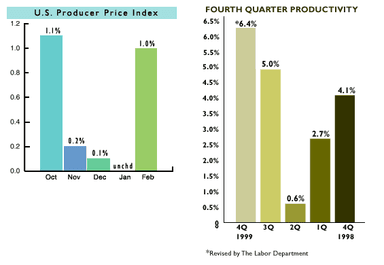
U.S. producer prices posted their biggest monthly jump in almost 10 years in February, reflecting a surge in crude oil prices, the government reported Thursday. However, the core rate, which excludes volatile food and energy costs, advanced at a more moderate pace.    The Producer Price Index jumped 1 percent last month, the Labor Department said, exceeding the 0.6 percent increase expected and above January's flat reading. It was the biggest jump in the main index since October 1990. The core rate, which excludes food and energy costs, rose 0.3 percent, in line with expectations and reversing January's 0.2 percent drop.Stripping out huge advances in energy and tobacco prices, inflation posted only a moderate advance last month -- suggesting to financial markets that the Federal Reserve's inflation-fighting interest rate increases may not come as fast and furious as many had been anticipating.    "Oil prices are important for the economy, but there continues to be no evidence that these increases are being monetized and passed on into the general structure of prices," said John Ryding, senior economist with Bear Stearns Inc. "We continue to expect that the Fed will boost rates by only 25 basis points at next week's (Federal Open Market Committee) meeting."The Dow Jones industrial average -- comprised of 30 companies that are generally more sensitive to rising interest rates -- took off at the opening bell as investors concluded that earnings will not be as significantly impacted by higher borrowing costs. Bonds also gained ground as investors gained reassurance that wholesale inflation remains subdued -- at least for the time being.Tame costs on the production line typically mean stable consumer prices, because producers do not have the rising costs that are typically passed on to buyers.    Fed officials meet next Tuesday in Washington to discuss monetary policy and the direction of short-term lending rates. Most Wall Street analysts expect the Fed will wrench up its benchmark rate for overnight loans between banks by another quarter point. That would be the fifth quarter-point increase since June. The rate now stands at 5.75 percent.    After today's numbers, some analysts expect the Fed may not have to press so hard on the brakes to slow down the economy. While most expect the U.S. economy to post growth upwards of 5 percent in the first three months of the year, very little evidence of accelerating inflation has emerged -- the main reason behind the Fed's recent spate of rate hikes.    ABS brakes?    "Most people were afraid that we'd start to see some inflation, but I don't think there's much here," said Robert Brusca, chief economist with Ecobest Consulting. "The Fed still has its foot on brakes and will keep tapping them at regular intervals, but perhaps not as much as investors had been expecting." (369KB WAV) (369KB AIFF)Indeed, almost all of February's gains came in the form of rising energy and tobacco prices. Energy prices for producers jumped 5.2 percent in February, the biggest increase since October 1990, reflecting a whopping 30.6 percent surge in the cost of home heating oil and a 12.9 percent jump in prices at the pumps for gasoline. In January, producers' energy costs rose 0.7 percent.    Those increases mirrored the recent surge in oil prices, which have almost tripled in price to as high as $34 a barrel in the past 14 months, reflecting concerns that the Organization of Petroleum Exporting Countries (OPEC) would not boost its output next month to prevent global shortages.    Tobacco prices, meanwhile, jumped 5.6 percent, more than reversing January's 4.2 percent drop. Cigarette prices rose 6.3 percent as manufacturers such as Philip Morris Cos. (MO: Research, Estimates) raised U.S. cigarette prices to distributors by 13 cents a pack, or about 7 percent. New York State also boosted taxes on cigarettes last month, raising the price on a single pack of 20 cigarettes to around $4.50 from around $4.Where's the inflation?    In other categories, food prices increased a moderate 0.4 percent in February, after rising 0.1 percent in January. Prices for new computers fell 3.3 percent, car prices fell 1.2 percent, and prescription drug prices declined 0.2 percent. Intermediate goods prices rose 0.8 percent last month, while crude goods prices rose 4.2 percent.    So why aren't prices rising? For one, there's productivity. Advances in technology have made companies better at producing and delivering wholesale goods cheaply and efficiently without raising their costs, ensuring prices at the retail level stay the same or even decline in some cases. Worker productivity advanced at a 6.4 percent annual pace in the fourth quarter.Another reason is competition -- from e-commerce companies on the Internet, from government deregulation of industries such as electricity and telecommunications, and from overseas firms who not only produce goods cheaply, but sell them to American producers in currencies that are worth less than the U.S. dollars those producers use to pay for them.    All that has led to increased output without higher prices -- a phenomenon that has framed the U.S. economy for more than three years, said Rob Palombi, a markets analyst with Standard & Poor's MMS. What's more, "the U.S. dollar has been on a firming path against the yen and the euro, which should help offset inflation risks on imported goods going forward."    After reaching near par against the yen in January, the dollar has risen to above 106 yen. It has also made steady ground against the euro, with the euro falling below parity in late January to trade around the 96-cent level.
article
Strong Sell
Strong Sell
133690
Mirae Asset TIGER NASDAQ100 ETF
+3
user
박재훈투영인
·
10 months ago
0
0
Changes in the Business Cycle(May 14, 1999)
In December 1998, the current expansion reached a milestone – it became the longest peacetime expansion in post-World War II U.S. economic history, surpassing the record previously held by the 1982-1990 expansion. In fact, if the expansion continues through January 2000, it will tie the expansion associated with the Vietnam War as the longest expansion since our records of such things start in 1854.The experience of the U.S. during the last twenty years has been quite remarkable. The long economic expansion of the 1980s was followed by a relatively short recession in 1990-91, and the economy has been expanding ever since. The U.S. has experienced only 8 months of recession in the last 16 years. The most visible sign of the continued expansion is provided by the unemployment rate. For the past year, it has remained below 4.5 percent, hovering at levels not seen since the early 1970s.Not surprisingly, the long expansion has raised questions about the whole notion of the business cycle. Extended periods of expansion always lead a few commentators to speculate that the conventional business cycle is dead. In 1969, for example, a conference volume titled “Is the Business Cycle Obsolete?” was published just as the 1961-69 expansion came to an end and the economy entered a recession. With two record-setting expansions in a row, and the current one still going, it is to be expected that the notion of regular business cycles is again being questioned. The current favorite hypothesis is that a “new economy” has emerged in which our old understanding of business cycle forces is no longer relevant.While few economists believe we have seen the end of business cycles (just look at Asia and Latin America!), the views of economists about business cycles have changed. These changes reflect real changes in the U.S. economy, changes in our ability to measure economic developments, and changes in economic theory.Dating business cyclesAlthough virtually all data used to analyze the U.S. economy are produced by some agency of the federal government, the standard dates identifying business cycle peaks and troughs are determined by the Business Cycle Dating Committee of the National Bureau of Economic Research (NBER). The NBER is a private, non-profit research organization whose research affiliates include many of the world’s most influential economists.The NBER defines a recession as “a recurring period of decline in total output, income, employment, and trade, usually lasting from six months to a year, and marked by widespread contractions in many sectors of the economy.” Recessions are, therefore, macroeconomic in nature. A severe decline in an important industry or sector of the economy may involve great hardships for the workers and firms in that industry, but a recession is more than that. It is a period in which many sectors of the economy experience declines. Recessions are sometimes said to occur if total output declines for two consecutive quarters. However, this is not the formal definition used by the NBER.Business cycle peaks and troughs cannot be identified immediately when they occur for two reasons. First, recessions and expansions are, by definition, recurring periods of either decline or growth. One quarter of declining GDP would not necessarily indicate that the economy had entered a recession, just as one quarter of positive growth need not signal that a recession had ended. The recession of 1981-82 provides a good example. Real GDP declined from the third quarter of 1981 to the fourth quarter, and then again from the fourth quarter to the first quarter of 1982. It then grew in the second quarter of 1982. The recession was not over, however, as GDP again declined in the third quarter of 1982. Only beginning with the fourth quarter did real output begin a sustained period of growth.Second, the information that is needed to determine whether the economy has entered a recession or moved into an expansion phase is only available with a time lag. Delays in data collection and revisions in the preliminary estimates of economic activity mean the NBER must wait some time before a clear picture of the economy’s behavior is available. For example, it was not until December 1992 that the NBER announced that the trough ending the last recession had occurred in March 1991, a delay of 20 months.Expansions and contractions since 1854U.S. business cycle peaks and troughs going back to the trough in December 1854 have been dated by the NBER. Based on their dates, we can ask whether basic business cycle facts have changed over time.One important aspect of a recession or an expansion is its duration. The lengths of recessions since 1854 are shown in Figure 1. Several interesting facts are apparent from the figure. First, measured solely by duration, the Great Depression of 1929-1933 pales in comparison with the 1873-1879 depression that lasted over five years. And the 1882-1885 recession lasted nearly as long as the Great Depression. Some lasting images of American history survive from this period, including the great debate over silver coinage.Second, while the Great Depression was not the longest period of economic decline, it does appear to represent a watershed; no recession since has lasted even half as long as the 1929-1933 contraction.Third, it is not just that recessions have been shorter on average in the post-World War II era, they have all been much shorter. Of the 19 recessions before the Great Depression, only three lasted less than a year; of the 11 recessions since the Great Depression, only three have lasted more than a year.Figure 2 shows the duration of economic expansions since 1854. Darker bars mark wartime expansions. Based on duration, the changing nature of expansions is not quite as evident as for contractions. But of the 21 expansions prior to World War II, only three lasted more than three years. In contrast, of the 10 expansions since, only three have lasted less than three years. Even if the wartime expansions associated with Korea and Vietnam are ignored, post-World War II expansions have averaged 49 months, compared to an average of only 24 months for pre-World War II peacetime expansions.Is the economy more stable?A simple comparison of the duration of expansions and contractions does suggest the U.S. economy has performed better in the post-World War II era. Recessions are shorter, expansions are longer. These changes strongly suggest that business cycles have changed over time. However, a simple comparison of duration cannot tell us about the severity of recessions or the strength of expansions. This would be better measured by the decline in output that occurs in a recession or the growth that occurs in an expansion. However, most studies that examine how volatile economic activity has been do conclude that output has been somewhat more stable in the post-World War II era.This conclusion, however, is not universally accepted. There are three reasons that comparing the business cycle over time is difficult.First, the quality of economic data has improved tremendously over the past 100 years. If the earlier data on the U.S. economy contained more measurement error because the quality of our statistics was lower, the measured path of the economy may show some fluctuations that simply reflect random errors in output data. This will make the earlier period look more unstable. In addition, earlier data on economic output tended to provide only a partial coverage of the economy. For example, better statistics were available on industrial output than on services. Since services tend to fluctuate less over a business cycle, the earlier data undoubtedly exaggerated the extent of fluctuations in the aggregate economy.Second, NBER dating methods have not remained consistent. Romer (1994) argues that the dating of pre-World War II business cycles was done in a manner that tended to date peaks earlier and troughs later than the post-World War II methods would have done. This contributes to the impression that prewar recessions were longer and expansions shorter.Third, the economy is increasingly becoming a producer of services, and productivity in the service sector is often difficult to measure. In general, the tremendous changes experienced in recent years associated with the information revolution are likely to affect the cyclical behavior of the economy in ways not yet fully understood.Implications for macroeconomic policyUnderstanding changes in the nature of the business cycle is important for policymakers. Most central banks view contributing to a stable economy as one of their responsibilities. Promoting stable growth has important benefits, and reducing the frequency or severity of recessions is desirable as part of a policy to ensure employment opportunities for all workers. Preventing expansions from generating inflation is also important since once inflation gets started, high unemployment is usually necessary to bring it back down.One might think, then, that policy designed to stabilize the economy should attempt to eliminate fluctuations entirely. This is not the case, for a very important reason. A business cycle represents fluctuations in the economy around full-employment output, but an economy’s full-employment output, often called potential GDP, can also change. It grows over time due to population growth, growth in the economy’s capital stock, and technological change. Developments in economic theory have led to a better understanding of how an economy adjusts to various disturbances. These adjustments can cause potential GDP to fluctuate, and it would be inappropriate for policy to attempt to offset these fluctuations. Identifying fluctuations in potential GDP from cyclical fluctuations can be difficult, however, as the current economic expansion illustrates. Is the economy in danger of overheating, risking a revival of inflation? Or have changes in the economy increased potential GDP?While the U.S. economy has enjoyed two consecutive record expansions, a longer historical perspective does help to remind us that business cycles are unlikely to be gone for good. Despite talk of the “new economy,” all economies experience ups and downs that are reflected in swings in unemployment, capacity utilization, and overall economic output. Though changes in the structure of the economy may alter the extent of these fluctuations, they are unlikely to eliminate them.In addition, the business cycle record is not independent of policy decisions. The economy may not have changed fundamentally; perhaps we have simply benefited from good economic policy (see Taylor 1998 for a discussion along these lines). With less successful policies, recessions could become more frequent and longer again. The Great Depression, for example, was prolonged by, among other things, poor economic and monetary policy decisions, and the recessions of the early 1980s were the price of policy mistakes in the 1970s that allowed inflation to rise significantly (Romer 1999). Thus, one reason business cycles can change, even if the underlying economy or source of disturbances haven’t, is because policymakers do a better (or worse) job of stabilizing the economy.
article
Strong Sell
Strong Sell
133690
Mirae Asset TIGER NASDAQ100 ETF
+3
user
박재훈투영인
·
10 months ago
0
0
United States: A hotly contested election could lead to economic overheating(31 / 10 / 2024)
An election with uncertain resultOn November 5th, Americans will head to the polls to decide between former President Donald Trump (Republican) and sitting Vice President Kamala Harris (Democrat). The outcome hinges on a few key "swing states" where no clear favorite has emerged. In addition to the presidency, control of Congress is at stake: Republicans need only two seats to reclaim the Senate, while Democrats need a net gain of four to take back the House. A divided Congress is likely, though a trifecta – control of both chambers and the presidency by one party – remains possible.Protectionism and trade risksA second Trump presidency would likely escalate protectionist trade policies, including substantial tariffs on imports, particularly from China. Trump has already pledged a 60% tariff on Chinese imports and broader tariffs on U.S. allies, which could severely disrupt global supply chains and raise costs for American businesses.In contrast, Harris would likely continue a more strategic and measured approach to trade, focusing on targeted restrictions, especially concerning China. However, trade tensions are expected to persist, especially in the technology and energy sectors.Diverging fiscal visionsHarris and Trump present significantly different fiscal policies. Harris aims to raise taxes on corporations and the wealthy, offering tax relief to lower-income families. Her platform emphasizes public investment in green infrastructure and social programs, seeking to reduce income inequality.Trump, for his part, wants to extend and broaden the tax cuts he introduced in 2017 and is also considering a cut in corporation tax to 15%. Furthermore, his approach is based on deregulating key sectors to promote economic growth, at the risk of increasing the public deficit.Inflation and economic uncertaintyBoth candidates’ platforms involve substantial public spending, raising concerns about inflation and interest rates. While household consumption is solid, a spike in inflation triggered by the implementation of either candidate's election manifesto could force the Federal Reserve to adopt a more restrictive monetary policy, thereby raising interest rates.Despite these risks, the U.S. dollar remains globally strong, ensuring favorable financing conditions for the country. However, should the Fed's independence come under threat in a second Trump term, confidence in U.S. monetary policy could waver, increasing global economic uncertainty.
article
Sell
Sell
453870
TIGER India Nifty 50
+1
user
박재훈투영인
·
10 months ago
0
0
Don’t bet on a recession in 2020(Dec 27th 2019)

PAUL SAMUELSON was the rare sort of economist who understood that a well-crafted joke can have a greater impact than pages of complex maths. One of his famous quips was that declines in the stockmarket have predicted nine of the last five recessions. The joke dates from the mid-1960s. But it may well turn out to have particular relevance for financial markets in 2020.Samuelson was one of the architects of the efficient-market hypothesis, which holds that stock prices, like oil prices and currencies, cannot be predicted. That is largely because such prices already have forecasts about events in politics and economics embedded in them. To predict the markets is to make forecasts about forecasts. If it were easy, we would all be rich.Even so, it is wrong to think that all such attempts are futile. Useful things can still be said about how the markets might behave in 2020. To start with, we have a handle on the immediate outlook for the economy. Leading indicators of the world economy point to a continued slowdown. Forecasts for GDP growth are being revised down. And fears of a recession in America are growing. As such worries take firmer hold, share prices are likely to suffer for a while—perhaps quite badly. Yet there is reason to believe that recession fears will recede later in the year. The big surprise in 2020 may well be how quickly the mood in markets starts to recover.Today’s investor anxiety is clearly evident in the thirst for rich-world government bonds, the safest of assets. In Germany and Switzerland, interest rates are negative not just on overnight deposits but also on bonds that mature in the distant future. Yields on ten-year bonds have dipped below short-term interest rates. In the past, this has been a reliable signal that a recession is coming. A survey conducted by Bank of America finds that two-fifths of fund managers expect one in the next year. The same proportion thinks the trade war between America and China will never be resolved. Surveys of business confidence are similarly gloomy.So the big question for markets in 2020 is whether there is something on the horizon that can spur a little optimism. Don’t expect much good news in the early part of the year; signs that the slump in business sentiment is starting to infect the confidence of consumers are more likely. As recession fears build to a peak, stock prices will come under greater pressure. Long-term bond yields will fall further in America and plunge deeper into negative territory in Europe.Yet misery is rarely eternal. There are forces at work to counter it. One is monetary policy. Sceptics are right to point out that with interest rates already so low, central banks are short of ammunition with which to fire up the economy. But interest-rate cuts in America and China, and bond purchases by the European Central Bank, will at least keep credit flowing smoothly to businesses and consumers. That will put a floor under stock prices.It will probably take more than that to lift overall spirits in financial markets. But it would be unwise to bet against such a revival by the end of 2020. If government-bond yields fall further, politicians will wake up to the logic of economic stimulus by fiscal means—tax cuts and spending increases, funded by borrowing. Such policies fell out of fashion because their implementation is often ill-timed: it takes an age for politicians to agree on anything. But as recession fears grow, the pressure on them will build. As investors start to price in aggressive fiscal stimulus, stock prices will revive and bond yields will start to rise. As Samuelson noted a half-century ago, the markets sometimes predict disasters that don’t happen; 2020 could be one of those years.
article
Sell
Sell
133690
Mirae Asset TIGER NASDAQ100 ETF
+6
user
박재훈투영인
·
10 months ago
0
0
Is the Labor Market Overheating?(APRIL 1, 2022)
Annmarie Fertoli: US employers are hiring at a brisk pace and the unemployment rate is nearing pre pandemic levels. But there are some worries, namely that record high job openings and higher wages could further fuel inflation. Federal Reserve Chairman Jerome Powell expressed concerns about that earlier this month when the Central Bank moved to raise interest rates for the first time since 2018. What does the latest jobs report mean for the Feds path going forward? I'm Annmarie Fertoli from the Wall Street Journal, and I'm joined now by Wall Street Journal, Chief Economics Correspondent, Nick Timiraos. Hi, Nick. Thanks for being here.Nick Timiraos: Thanks for having me.Annmarie Fertoli: Nick, overall we saw strong hiring last month, but this is actually something that could pose a challenge for the Fed, which is closely eyeing whether or not this economy right now is overheating. Can you explain those dynamics for us?Nick Timiraos: Well, the Fed is concerned about inflation running too high, and initially the Fed thought that was primarily happening because of a shortage of goods leading to extreme price pressures for a high handful of things like used cars and new cars. But the concern now is that inflation is broadening to include a broader range of goods and also services. And if you think about the services that we purchase, whether it's haircuts, or restaurant meals, those are things where labor is the main expense. And when you begin to see pressures driving wages higher, that adds to the Fed's concern that inflation is going to be harder to get out of the economy than if it were just rising because of some idiosyncratic price increases for things like used cars.Annmarie Fertoli: Now, how does the Fed usually handle these dueling mandates of achieving maximum employment while keeping inflation near the target 2%? We know that inflation hasn't been near that Fed target for quite some time now.Nick Timiraos: Well, sometimes as you note, the mandates can be in conflict. Right now, they're not. Right now, you have very strong employment and very high inflation. And the Fed will look at that and say, "Obviously we need to raise interest rates." Right now, interest rates are just below a half percentage point and the Fed thinks that a neutral rate, which would be where you're no longer providing stimulus, but you're not necessarily stepping on the brakes. They think that's somewhere between 2 and 3%. We're nowhere near their estimates of what a neutral rate would be. Right now, the Fed is on a clear path to get interest rates up this year to something around 2% give or take. The question's going to be, what do you do after that if the economy's still standing strong and inflation's still coming in high? Inflation results when there is an imbalance of supply and demand. The Fed can't do anything about supply of oil, shortages of cars. They can't fix the supply side of the economy. The only way for them to really bring supply and demand into balance in the short run is to reduce demand. And that's what would begin to happen once they get interest rates to neutral. If they decide to keep raising interest rates, they would be trying to deliberately slow down the economy, destroying demand, weakening the job market in order to get inflation to come down.Annmarie Fertoli: We know that the Fed is planning to raise interest rates several times this year. What does the latest data from the jobs report mean for how Fed officials might proceed at their next meeting in May?Nick Timiraos: The big question at the May meeting is not whether the Fed will raise interest rates, it's by how much. Traditionally, when the Fed raises interest rates, they move in just a quarter percentage point increment, but there are times when the data might call for a larger increase, a half percentage point increase. Now, the Fed has not raised interest rates by a half percentage point since 2000, but we haven't been in an environment where inflation's this high and where the unemployment rate is this low. When the unemployment rate fell to this half century low level in 2018 and 2019, inflation was at 2%. The big question now is really will the Fed do a supersized half percentage point interest rate increase in May? And the report from the Labor Department here gives them a green light to do a half point increase if they want to.Annmarie Fertoli: And what does the latest jobs report mean for the Fed's plans to unwind its $9 trillion asset portfolio?Nick Timiraos: The Fed has two tools that they've used to provide stimulus, which is cutting interest rates during the crisis. They cut rates to zero and then after that they purchase longer term bonds and mortgage backed securities, again, to push rates even lower. Now, as they're unwinding their stimulus, they're raising interest rates, but they're also preparing at their May meeting to announce a plan to shrink the asset holdings to allow that stimulus to reverse. And it's very likely that the Fed will begin to do that. And it's a double barreled form of policy tightening. It's not something that the Fed has a lot of experience with because they've only done this one other time after they expanded their asset portfolio. After the 2008 recession, they unwound it a little bit in 2017, 18, and 19. Now they're talking about more aggressively running down the securities holdings in that portfolio. It's very much going to be trial and error, wait and see, Fed Chair J Powell is talking about being humble and nimble. And that suggests that the Fed is doing something they don't have a lot of experience doing, which is to bring inflation down when it's way above its target, possibly raising rates a lot more than they have in the last two decades all while shrinking their asset portfolio.Annmarie Fertoli: All right. That's Wall Street Journal Chief Economics Correspondent, Nick Timiraos. Nick, thanks so much for your time today.
article
Sell
Sell
133690
Mirae Asset TIGER NASDAQ100 ETF
+1
user
박재훈투영인
·
10 months ago
0
0
Powell Pushes Back on Concerns of Prices Rising, Overheating(2021년 2월 25일)
Federal Reserve Chair Jerome Powell emphasized his view that the economy has a long way to go in the recovery and signs of prices rising won’t necessarily lead to persistently high inflation.“Our policy is accommodative because unemployment is high and the labor market is far from maximum employment,” he told the House Financial Services Committee on Wednesday, in his second day of testimony to Congress. “It’s true that some asset prices are elevated by some measures.”Powell pointed to the example of car prices rising because of a chip shortage and supply-chain constraints in the tech industry.“That doesn’t necessarily lead to inflation because inflation is a process that repeats itself year over year over year,” he said, rather than a one-time surge.In multiple questions from lawmakers about the risk of the economy overheating -- with additional government aid and continued support from the central bank -- the Fed chair reiterated his view that there’s a long way still to go before returning to pre-pandemic strength.U.S. stocks reversed losses and turned positive as he reaffirmed his view that the economy needs help. Government bond yields jumped along with oil prices.Inflation ConcernsHis remarks were echoed by officials speaking elsewhere on Wednesday. Fed Vice Chair Richard Clarida expressed cautious optimism on the outlook but said it would “take some time” to restore the economy to pre-pandemic levels. Govenor Lael Brainard warnedthat inflation remained “very low” and the economy was still far from the Fed’s goals.Powell acknowledged that the central bank does expect inflation to move up because of “base effects” and a surge in demand as the economy reopens from shutdowns during the virus outbreak. But he emphasized that central bank has “the tools to deal with it.”Powell delivered his remarks as signs appear that the economy is strengthening and as optimism grows with the distribution of vaccines. Markets are also expecting further fiscal stimulus from President Joe Biden and Congress.That prospect is setting the stage for a shift away from historically low Treasury yields and energizing the global economic trade, driving up commodities prices and inflation expectations.Read More: Treasuries Rout Accelerates as Quants Deepen Global Debt SelloffDuring the hearing, Powell voiced confidence that the Fed would succeed in lifting inflation and getting it to average 2% over time.“I’m confident that we can and that we will, and we are committed to using our tools to achieving that,” he said. “We live in a time where there is significant disinflationary pressures around the world and where essentially all major advanced economy’s central banks have struggled to get to 2%. We believe we can do it, we believe we will do it.”Powell said that “it may take more than three years” to reach that goal but vowed to update the Fed’s assessment on the issue every quarter. ​
article
Sell
Sell
453870
TIGER India Nifty 50
user
박재훈투영인
·
10 months ago
0
0
The World Economy Risks Turning Too Hot to Handle(2018년 3월 16일)
The world economy risks growing too fast for its own good.Group of 20 finance ministers and central bankers meet next week in Argentina amid the broadest and strongest economic upswing since 2011, with President Donald Trump’s tax cuts adding a dose of accelerant. They convene days after the Organisation for Economic Co-operation and Development raised its forecasts to show global growth of 3.9 percent this year and next.For policy makers and investors, the key questions are how much faster can the world grow -- and do they even want it to if overheating means an inflationary boom is followed by another bust.Global growth has only matched or bettered 3.9 percent 8 times since 1990 and HSBC Holdings Plc notes every synchronized upswing since then presaged an abrupt shock. The peak of 5.6 percent in 2007 was followed by the financial crisis a year later.“When lots of countries are growing strongly, the global economy is at its most vulnerable, thanks to heightened interest rate and financial risks,” said Stephen King, senior economic adviser at HSBC.In a study of 50 economies published last month, King observed that the credit-crunch recession hit the U.S. in 1990 after a period of robust global demand and then bond markets collapsed in 1994 following another growth spurt. The next boom in 1997 came before the Asia crisis and then the world was buoyant from 2004 to 2007 until the worst recession since the Great Depression.Signs are already appearing that activity is now looking toppish as the Federal Reserve and other central banks tighten monetary policy, China curbs borrowing and Trump implements tariffs. Citigroup Inc. calculates data in major economies are currently undershooting forecasts by the most since September and measures of manufacturing confidence appear to be cresting, albeit at lofty levels.“Even though the sun still shines in the global economy, there are more clouds on the horizon,” International Monetary Fund Managing Director Christine Lagarde said in a blog post addressed to G-20 policy makers. “Think of the growing concerns over trade tensions, the recent spike in volatility in financial markets, and more uncertain geopolitics.”The fear of a trade war will be high on the agenda in Buenos Aires, with Bloomberg Economics estimating such an event could wipe $470 billion off the world economy by 2020.Read more on the risks associated with a global trade warInvestors seem placated for now. Global stocks were roiled in January amid concern a pickup in U.S. inflation would force central banks to react, yet subsequent data showed price pressures remain muted even as companies keep hiring.“Overheating -- in the form of a sharp pick-up in inflation -- is still a good way into the future,” Robin Brooks, chief economist at the Institute of International Finance, said of the U.S.In a report to clients on Thursday, Nomura Holdings Inc. economist Andrew Cates wrote that there is “plenty of scope for this cycle to mature” because tightening labor markets and stronger demand should prompt companies to invest and productivity to advance, allowing the global expansion to continue.There could still be trouble ahead.In the U.S., tax cuts and government spending are stoking demand but could end up provoking the Fed into raising interest rates more aggressively than policy makers now plan, risking another fallout in financial markets. Unemployment is already at 4.1 percent and could fall further.Fitch Ratings said on Thursday that “booming” global conditions will trigger central banks to raise interest rates.“The Fed will need to move rates materially higher over the next few years to head off overheating risk two to three years out,” said Krishna Guha, vice chairman at Evercore ISI in Washington.Still, incoming White House economic adviser Larry Kudlow urged the Fed not to “overdo it” in raising interest rates: “Growth is not inflationary. Just let it rip, for heaven’s sake,” he told CNBC in an interview.
article
Sell
Sell
133690
Mirae Asset TIGER NASDAQ100 ETF
+1
user
박재훈투영인
·
10 months ago
0
0
Fed chief Powell says no evidence U.S. economy overheating(March 2, 2018)
Federal Reserve Chairman Jerome Powell said on Thursday the U.S. economy does not appear to be running hot, even as the influential head of the New York Fed suggested a faster pace of interest rate increases may still be in the offing for 2018."There is no evidence the economy is overheating," Powell told the Senate Banking Committee in his second appearance in Congress this week, saying he expects the Fed to stick with a "gradual" pace of monetary policy tightening.But in remarks at an event in Sao Paulo, Brazil, New York Fed President William Dudley said "gradual" could still apply to a scenario in which borrowing costs were raised four times this year, instead of the three moves Fed policymakers projected when they issued their last set of economic projections in December.Yet the Fed officials' comments were overshadowed by President Donald Trump's announcement of a plan to raise tariffs on steel and aluminum imports, the sort of move Fed policymakers have warned about since the Republican took office last year.Such action, and the risk of retaliation by trading partners, could cloud the U.S. economic outlook and derail the global recovery currently benefiting the United States.Traders of federal funds futures trimmed bets on a fourth rate increase this year after Trump's announcement. U.S. stock indexes fell sharply, with the S&P 500 <.SPX> index down about 1.3 percent in a third consecutive day of losses.In his testimony, Powell described trade as a "net positive" while conceding it created some losers in the economy, and said "the tariff approach is not the best approach. The best approach is to deal directly with the people who are affected rather than falling back on tariffs."The Fed is expected to increase rates at its March 20-21 policy meeting. Policymakers will also issue fresh forecasts that will indicate whether the core of the rate-setting Federal Open Market Committee has shifted its view.'APPROPRIATE PATH'Powell's twin appearances this week showed that he and the rest of the Fed are wrestling over how to square an economy that is strong on many levels, and possibly about to get at least a short-term boost from tax cuts, but still lacks the kind of inflation and wage gains that would prompt faster Fed action on rates.To some policymakers, the absence of price pressures means the Fed should stand back, wait for wages to gain steam, and give workers a chance to make up ground lost due to the 2007-2009 financial crisis and its aftermath even at the risk of faster inflation in the future."Similar numbers of participants see upside risk to the outlook and downside risks on inflation," analysts from Barclays wrote in a recent note. "If policy is to move faster, or slower, one of these groups needs to gain additional members."Earlier on Thursday, the Commerce Department reported that consumer prices increased in January, with a gauge of underlying inflation posting its largest gain in 12 months. The report added to the sense that inflation is moving up to the Fed's 2 percent target.In prepared remarks for his testimony this week, Powell pledged to "strike a balance" between avoiding any rapid rise in prices while keeping the recovery on track in the hope that the tight job market finally produces significant wage gains.He also acknowledged, in response to lawmakers' questions, that the labor market may have room to strengthen further, given uncertainty about the level of "full employment," a concept generally associated with faster rising wages and prices.Though the current U.S. unemployment rate of 4.1 percent was "at or near or even below" many estimates of the full employment rate, "we don't see any evidence of a decisive move up in wages ... Nothing in that suggests to me that wage inflation is at a point of acceleration," Powell told the Senate panel on Thursday.Powell said risks are "more two-sided" now than early in the recovery, adding that "the thing we don't want to have happen is to get behind the curve."But he said at this point the Fed could continue "to gradually raise interest rates ... That is the path we have been on and my expectation is that will continue to be the appropriate path."Since Powell's appearance before the House of Representatives Financial Services Committee on Tuesday, markets have been looking for clarity over whether the Fed will accelerate the pace of its rate increases this year.Powell's bullish comments about the economy on Tuesday sparked a jump in U.S. bond yields and drop in stocks.Reporting by Howard Schneider; Additional reporting by Pete Schroeder and Jason Lange in Washington, Jonathan Spicer in New York and Ann Saphir in San Francisco; Editing by Paul Simao
article
Sell
Sell
133690
Mirae Asset TIGER NASDAQ100 ETF
+1
user
박재훈투영인
·
10 months ago
0
0
Economists React: China's GDP Shows Signs of Overheating(April 15, 2010)
China's latest economic data show an attention-getting 11.9% surge in the first quarter's gross domestic product, combined with moderate inflation and slowing investment spending. Although China's leadership is clearly worried about a real-estate bubble, their next step is not obvious. Economists highlight what the mixed signals might mean for the future:Growth is strong, but there are signs of overheating. With stimulus already partly removed, the key is whether the authorities can steer the economy onto a more sustainable growth path, or whether generalized inflation and/or an asset bubble will break out in the second half and then trigger a bigger policy-induced slowdown for China in 2011. - Stephen Green, Standard CharteredWith 11.9% year-on-year GDP growth surpassing potential growth, overheated demand not only exhausts spare resources but also overstretches the supply capacity of raw materials, energy and infrastructure, leading to rapid upward pressure on prices. This is likely to be exacerbated by the fast export recovery, given that warming global demand puts new orders to China's manufacturers which exhausts the spare manufacturing capacity and ultimately adds pressures on consumer goods. ... In sum, the latest data releases have pointed to rising overheating and inflation risks. -- Qu Hongbin, HSBCThe acceleration in growth argues for further policy tightening. Yet, the call is not straightforward. CPI inflation is currently lower relative to the last two tightening periods in 2004 and 2007. The government is also concerned about producing a 2008-style correction in the property market. ... The fact that residential investment is the major driver of growth remains a concern. Residential apartments are a more politically sensitive issue than, for instance, steel factories, meaning the government may be reluctant to tighten as aggressively as it has in the past towards other sectors. - Ben Simpfendorfer, Royal Bank of ScotlandCPI inflation remains muted, at least for now. However, after four quarters of consecutive above-potential-level of GDP growth we believe the output gap is closed. We think in absence of a dramatic fall in external demand, it is critical for the government to tighten policy more decisively than they have been doing in order to prevent overheating. However, as CPI inflation remains low for now and policymakers remain very cautious on the external demand outlook we are likely to see more decisive tightening measures after CPI inflation rises to a relatively high level of say 3%-4%. - Yu Song & Helen Qiao, Goldman SachsWith growth now strong but headline inflation still subdued, the government has a window of opportunity to reign in the policy stimulus before it tips over into excess. ... On interest rates, the government is faced with an unpalatable choice: raise rates and damp the ardor of investors in the real estate sector, or leave rates on hold and allow the property bubble to expand further, and risk inflationary expectations taking hold. - Tom Orlik, Stone & McCarthy Research AssociatesFor now, the print of data does change the economic policy debate. There has been growing speculation that China may move on interest rates in response to the stronger property data (both volume and price) in April. We believe that the better than expected price data in March will be sufficient to keep the PBoC sidelined until the second half of the year. ... China's exit strategy continues to be one of subtlety and restraint. - Glenn Maguire, Societe GeneraleThe acceleration in year-on-year growth in Q1 was entirely due to weakness a year ago. Growth has continued to slow in quarter-on-quarter terms and the economy is now expanding at an unremarkable pace. Price pressures too seem to be easing. While we expect policy tightening over the coming quarter, there is no need for dramatic measures. - Mark Williams, Capital Economics
article
Sell
Sell
133690
Mirae Asset TIGER NASDAQ100 ETF
+2
user
박재훈투영인
·
10 months ago
0
0
4 signs the stock market is overheating(July 1, 2014)
The markets are in a state of ecstasy, but investors may be underestimating lurking danger.CNNMoney took a look at a slew of recent data on stock valuations and corporate sentiment, and while the prospects for global economic growth remain robust, savvy investors need to stay vigilant.Here are the most four worrying signs for the markets right now:1. Addiction to the Fed stimulus: Simply put, the financial markets are hooked on easy money, and that has caused them to ignore real economic and geopolitical vulnerabilities, according to an annual report released Sunday by the Bank for International Settlements (BIS), an organization of of central banks.While the Federal Reserve and other central banks are widely credited with shoring up the financial system after the crisis by keeping interest rates low and driving investment into stocks, investors may have gotten ahead of themselves."It is hard to avoid the sense of a puzzling disconnect between the markets' buoyancy and underlying economic developments globally," the report said.Related: America's 6 biggest public pensionsThe BIS noted that investors aggressive search for yield has driven them into riskier European and emerging market bonds, as well as lower rated corporate debt. That has left them exposed to a host of problems should interest rates rise quickly or economic conditions deteriorate."Countries could at some point find themselves in a debt trap: seeking to stimulate the economy through low interest rates encourages even more debt, ultimately adding to the problem it is meant to solve," asserted the BIS.2. Stocks are downright expensive: According to a popular metric of market valuation, stocks are trading at lofty levels previously experienced leading up market crashes. According to the Shiller PE Ratio, which tracks inflation-adjusted earnings over the past 10 years, the S&P 500 is currently trading at over 26 times earnings. The long-term average, going back more than 130 years, is 16.5.The Shiller price-to-earnings ratio rose above 25 for the first time in 1901, then again in 1929. At the height of the tech stock craze in 2000, the ratio hit a record peak of 44 before the market collapsed. It was back above 25 in 2003 and stayed around that level until 2007 -- shortly before the so-called Great Recession.Source: Data from multpl.com based on Shiller PE RatioAccording to research by Credit Suisse, once it rises above 26, U.S. stock market returns are typically negative for the next five years.3. Markets are far outpacing actual growth: Stocks are priced in the stratosphere compared to the overall health of the U.S. economy. David R. Kotok, Chairman and Chief Investment Officer at Cumberland Advisors in Sarasota, Florida, says that the only other time the total valuation of the stock market relative to U.S. growth domestic product (GDP) was higher was at the peak of the tech bubble."We think the probability of a correction is rising. It is very hard to pinpoint," Kotok explained in a research note Sunday.Still, Kotok is stripping out the first quarter's decline in GDP for his calculations, and he admits that "GDP is not a perfect trading guide."Related: 3 reasons not to freak out about -2.9% GDPBut "it does express that, when stocks are highly priced in the aggregate relative to GDP, the probability is higher that markets are becoming fully valued."Worst Q1 GDP since recession4. Corporate leaders aren't so optimistic anymore: In a survey revealed Monday by accounting and consulting behemoth Deloitte, Chief Financial Officers in the United States have lowered their earnings expectations for the year, with CFOs in manufacturing feeling particularly pessimistic.CFOs' expectations for capital spending also fell, the Deloitte survey found."Net optimism is holding steady, but lower earnings and capital spending growth expectations suggest U.S. CFOs are factoring in bumps that were not on their radar screens three months ago," said Deloitte's Sanford Cockrell III in a press release.
article
Sell
Sell
133690
Mirae Asset TIGER NASDAQ100 ETF
user
박재훈투영인
·
10 months ago
0
0
Mortgage Crisis Spirals, and Casualties Mount(March 5, 2007)
Even in affluent Orange County, Calif., the growing wealth of executives and brokers in the booming mortgage industry was hard to miss.For Kal Elsayed, a former executive at New Century Financial, a large lender based in Irvine, driving a red convertible Ferrari to work at a company that provided home loans to people with low incomes and weak credit might have appeared ostentatious, he now acknowledges. But, he says, that was nothing compared with the private jets that executives at other companies had.“You just lost touch with reality after a while because that’s just how people were living,” said Mr. Elsayed, 42, who spent nine years at New Century before leaving to start his own mortgage firm in 2005. “We made so much money you couldn’t believe it. And you didn’t have to do anything. You just had to show up.”Just as the technology boom of the late 1990s turned twenty-something programmers into dot-com billionaires, and leveraged buyouts a decade earlier turned Wall Street bankers into Masters of the Universe, the explosive growth in subprime lending turned mortgage bankers and brokers into multimillionaires seemingly overnight.Now an escalating crisis in the market, which seemed to reach a new crescendo late last week, is threatening a wide band of people. Foremost are the poor and minority homeowners who used easy credit to buy houses that are turning out to be too expensive for them now that mortgage rates are going up, but the pain is also being felt widely throughout the business world.Large companies that bought subprime lenders during the boom, like H&R Block and HSBC, are now scrambling to sell them or scale back their exposure. Many investors are also likely to suffer: Wall Street firms made billions in fees, commissions and trading revenue from packaging and selling subprime mortgages to them as bonds.New Century has emerged as a poster child for the lenders that rode that boom to the top and are now in free fall. The company disclosed on Friday that federal prosecutors and securities regulators were investigating stock sales and accounting errors. The latter could jeopardize billions of dollars in financing for the company, which issued $39.4 billion in subprime loans in the first nine months of last year.Weakening home prices and rising default rates have rocked the subprime business. But for those who cashed out before the market turned, the ride up was particularly sweet. The three founders of New Century, for example, together made more than $40.5 million in profits from selling shares in the company from 2004 to 2006, according to an analysis by Thomson Financial. They collected millions of dollars more in dividends, salaries, bonuses and perks.The company said in a statement yesterday that the founders were “still significant shareholders,” noting that they collectively owned about 7 percent of the company at the end of last year.New Century’s stock price, which seemed to mirror the trajectory of the subprime business, peaked at nearly $66 a share in December of 2004 and traded in the $40s most of last year; on Friday, it was trading at $11 a share after the market closed. In a series of sales from August to November, two of the company’s founders sold shares for an average price of about $40 a share, for a total profit of $21.4 million.It is not known whether the stock sales by the founders are among the sales being examined by federal investigators. Some of them had been part of scheduled stock sales that are often used by executives to diversify their portfolios. But some of the sales occurred on the same day that the executives entered the plans. A New Century spokeswoman, Laura Oberhelman, said that executives declined further comment.The founders’ stock also rose in the social circles of southern California, the epicenter of the boom in subprime. Five of the 10 biggest providers of subprime mortgages last year had their headquarters in the region.Robert K. Cole, 60, a co-founder who retired as chairman and chief executive last year, lives in a 6,100-square-foot oceanfront home in Laguna Beach that is valued at tens of millions of dollars and was once owned by the chief executive of Pimco Advisors, the giant bond trading and management firm. Edward F. Gotschall, 52, another co-founder who is vice chairman of the board, donated $3 million for an expanded trauma center at Mission Hospital that will be named for him and his wife Susan.The executives from New Century are by no means alone in cashing in on the bonanza, and they do not appear to have scored the biggest profits. That title may be claimed by Angelo R. Mozilo, the chief executive of Countrywide Financial, the nation’s largest stand-alone mortgage company and one of the largest subprime lenders last year. He reaped more than $270 million in profits from sales of stock and the exercise of stock options from 2004 to the start of this year, according to the Thompson analysis.Of course, most of the 500,000 people who work in the mortgage industry did not cash in so grandly. The wealth was concentrated among executives, loan officers and brokers, because the greatest rewards were meted out in the form of commissions, bonuses and stock awards.“In the hot times, it was not unusual to see a broker make a million bucks,” said Guy Cecala, publisher of Inside Mortgage Finance, a trade publication. “You can carry that up further to people who ran the companies. The whole business revolves around personal compensation.”The hot times are clearly over.New Century’s disclosure of the federal investigations on Friday was the most serious in a string of shocks to have rocked the industry in the last three months.A handful of lenders have sought bankruptcy protection, several have been acquired and a few have been shut down. Also on Friday, Fremont General, a top-five lender, said it planned to leave the business.Industry officials say they are seeing an exodus of executives and salespeople as companies fold, cut jobs and push out early leaders.“Everyone has run for the hills,” said William D. Dallas, whose company, Ownit Mortgage, filed for bankruptcy protection in December after it lost financing from Merrill Lynch and other banks.For the borrowers of these mortgages, it may become more difficult to refinance if lending standards are tightened significantly. Many are already facing the prospect of payment shock when low, fixed-interest mortgage rates adjust to higher, variable rates.On Wall Street, big investment banks could lose a significant source of revenue if the appetite for bonds backed by mortgages dries up.In the last two years many skeptics began warning that the red-hot housing market and adjustable-rate loans would blend into a toxic brew. Last year, subprime loans totaled $600 billion, or about 20 percent of all mortgages, up from $120 billion and 5 percent in 2001, according to Inside Mortgage Finance. More than half of subprime loans have adjustable rates.Many of the problems that have surfaced thus far are not tied to the resetting of rates. Rather, they stem from a sharp and early spike in the default rates among loans issued last year.For example, about 13.8 percent of the loans in a group of mortgages New Century sold to investors in April were behind in payments or in foreclosure by January. By comparison, only 6 percent of loans in a pool sold to investors in March 2005 had met that same fate by January 2006.Investors and regulators fear that the problems will only worsen as so many borrowers have fallen behind so quickly, especially at a time when the overall economy is healthy. The phenomenon suggests that lending standards were significantly weakened last year and that lenders were not as watchful for fraudulent transactions.For New Century, the early payment defaults pose significant financial problems. In the first nine months of last year, Wall Street banks and investors that it does business with forced it to buy back $469 million in loans it had sold to them, up from $240 million for the same period in 2005.The company was able to sell back about half of those loans at a discount of 26.5 percent. How it handled the remainder — about $227 million — is now under scrutiny. According to accounting rules the company should have valued the loans on its books for what they were worth today, not their previous face value. But it did not.If it had, the company would have seen its earnings fall by about $60 million before taxes, wiping out most of its profit in the third quarter, according to Zach Gast, an analyst at the Center for Financial Research and Analysis, a forensic accounting firm.This is important, because the company’s financing agreements require that it not lose money for any rolling six-month period. On Friday, New Century said it did not expect to make a profit in the six months that ended in December and that it was negotiating with lenders to waive the requirement but has only secured six of 11 waivers it needs.“They had losses sitting on their balance sheets,” Mr. Gast said.In August, the company’s chief financial officer, Patti M. Dodge, announced she was stepping down from her post to oversee investor relations, a department that typically reports to the chief financial officer. Taj S. Bindra, a former executive at Washington Mutual, replaced her in November.For the second time in a decade, New Century finds itself fighting to survive. The firm’s roots were planted at Plaza Home Mortgage Bank where the three founders of New Century — Mr. Cole, a longtime mortgage executive; Mr. Gotschall; and a lawyer named Bradley A. Morrice — worked together. The three formed New Century in 1995 after Plaza was sold to Fleet Mortgage Group, now a part of Washington Mutual.In the late 1990s, New Century narrowly survived accounting concerns and a scare in the bond market after Russia’ s default in 1998. It pulled through thanks to an investment by U.S. Bancorp, a bank based in Minneapolis.With interest rates at historic lows, it quickly grabbed a big share of the fast-growing subprime market during the housing boom.“They walked into a niche industry at a time when everything was lining up perfectly for what they did,” said W. Scott Simon, a managing director at Pimco Advisors. “In 2001, 2002 and 2003 the subprime business was just phenomenally profitable. Home prices kept appreciating and it seemed that no loans ever went bad.”
article
Sell
Sell
329200
TIGER REITS REAL ESTATE INFRA
+6
user
박재훈투영인
·
10 months ago
0
0
U.S. Service Industries Lose Momentum(2018-8-3)
The U.S. service sector’s rapid expansion cooled in July, though most industries indicated business remains solid.An index of nonmanufacturing activity—reflecting industries such as hair-cutting and accounting—fell to 55.7 in last month from 59.1 in June, the industry group Institute for Supply Management said Friday. That marked the lowest level in almost a year. Any reading above 50 indicates rising activity, as determined by factors such as production, sales and prices.Economists surveyed by The Wall Street Journal had expected a reading of 58.5.Service industries make up most of the economy. The report suggests the sector remains healthy and growing—sales, production and exports all continued to rise as they have been in recent years. But growth in each slowed last month.Businesses struggled to meet demand for their services in part because they are having trouble finding workers, said Anthony Nieves, head of the ISM survey. Unemployment, at 3.9% in July, is near the lowest level in years. He also pointed to worries about trade disputes between the U.S. and other countries, including China, that might be affecting business plans.Mr. Nieves said activity had risen so quickly earlier this summer that the economy was at risk of overheating. In July, the sector reverted back to the trend of recent years, which he said reflected more balanced, steady growth. Economic output in the U.S. grew at a 4.1% rate in the second quarter, the fastest in nearly four years, and many private-sector economists are calling for 3% growth in the current quarter.“This helps us with a little bit of cooling off right now,” Mr. Nieves said, adding: “It’s better than the economy overheating.”Comments from companies in the survey suggested they remain upbeat.“Current local and national conditions are good,” one executive from the finance and insurance industry said in the survey. “On track to meet goals and projections for 2018.”The report showed companies stepped up hiring to meet demand. An index of hiring across service industries picked up, rising to 56.1 in July from 53.6 in June.Meanwhile, inflation pressures rose. An index of prices for materials and services climbed to 63.4 in July from 60.7 a month earlier.Write to Josh Mitchell at joshua.mitchell@wsj.com
article
Sell
Sell
user
박재훈투영인
·
10 months ago
0
0
U.S. Factory Sector Clocks Strongest Growth in 14 Years(2018-9-4)
WASHINGTON—American factory activity in August expanded at the strongest pace in more than 14 years, despite rising tensions with some of the U.S.’s largest trade partners.The Institute for Supply Management on Tuesday said its manufacturing index rose to 61.3 in August, the highest level since May 2004, from 58.1 in July. Sales of factory-made products, or new orders, output and employment all grew at a faster pace in August.Tuesday’s release surprised analysts who had expected a slowdown in the industry in light of rising trade tensions and a typically weaker month for factory activity. Economists surveyed by The Wall Street Journal had expected a 57.5 reading for August.“Despite concerns over U.S. protectionist policies, manufacturing sentiment remains on a solid footing, supported in large part by firm domestic demand,” said Pooja Sriram, U.S. economist at Barclays.The U.S. and Europe, China and other countries are in the midst of trade battles stemming from steel and aluminum tariffs the Trump administration enacted earlier this year.Mohamed A. El-Erian, chief economic adviser at Allianz, tweeted, “In addition to highlighting the strength of the U.S. #economy, this also points to the more general theme of divergence in advanced countries’ economic performance and policies.”Though most economists hailed Tuesday’s report as a sign of robust growth continuing into the second half of 2018, some analysts said there are signs of overheating in the manufacturing industry.“The last time we have seen something akin to the current run late in an expansion occurred in” the late 1980s, when the Federal Reserve had to raise the fed funds target rate to almost 10% to tamp down inflation, according to Stephen Stanley, chief economist at Amherst Pierpont Securities. “If you want to conclude from this quick history lesson that the Fed is currently too easy and in the process of making a policy mistake, I would not object.”Most private economists expect the Fed will raise short-term interest rates two more times this year, once in September and again in December, with strong economic data continuing to roll into the summer months.Despite the headline growth in factory activity, there are latent signs recent trade actions may be beginning to take a toll. An underlying gauge of new export orders for primary metals, transportation equipment and machinery declined in August, with machinery last declining at the beginning of 2017.“We’re a significant exporter of railcars, airplanes, automobiles…Machinery is our number 6 industry sector,” said Tim Fiore, who oversees the ISM survey of factory purchasing and supply managers. “If export markets are closed off to us, orders will go down, [then] exports and production.”Trade tensions, coupled with what appear to be economic slowdowns in some of the U.S.’s biggest trading partners, could be headwinds for the manufacturing sector.Tuesday’s ISM report also showed a measure of inflation grew at a slower pace; the Backlog of Orders Index continued to expand, at higher levels compared with the previous month; and imports grew at a slower pace.Broader economic growth picked up robustly in the second quarter after a modest slowdown in the early months of 2018. The unemployment rate declined below 4% this spring and forecasters expect solid growth this year, supported by recent tax cuts and strong consumer sentiment.Write to Sharon Nunn at sharon.nunn@wsj.com
article
Sell
Sell
Nowcast
user
SellSmartR
·
5 months ago
0
0
CORE16 Model Forecasts June CPI at 2.6 Percent
You can check out CORE16’s proprietary CPI forecasting model at the link below.👉 https://core16-cpi-nowcast.streamlit.app/CORE16 CPI model predicted June CPI (to be announced in July) at 2.6 percent.What is CPI, and Why Does It Need to Be PredictedThe Consumer Price Index (CPI) is not just a basic inflation number.CPI is one of the most important economic indicators that moves interest rates, bonds, and equity markets.The Federal Reserve, in particular, uses CPI as a core reference when setting monetary policy.In that sense, understanding CPI is essentially predicting the direction of the market.But CPI is released with a lag—each month’s figure is reported in the following month.Before the official number comes out, the market has no choice but to rely on speculation, and that gap in visibility has long created differences in investor timing. To address this gap, the Cleveland Fed developed a CPI nowcasting model.By incorporating high-frequency data such as oil prices, food costs, and gasoline prices,the model provides real-time CPI estimates even before official releases.It is structurally simple, but its speed and interpretability have earned it a strong reputation as a practical tool for market insight.Inspired by the Cleveland Fed, CORE16 built its own CPI forecasting model tailored for domestic investors.Rather than focusing on complex algorithms, the goal was clear:deliver the fastest and most reasonable estimate based on the latest available data. The CORE16 model updates daily in real time.Between 2024 and March 2025, it reduced forecast error by approximately 20 percent compared to existing methods.Looking ahead, CORE16 plans to expand beyond CPI to cover employment data, retail sales, corporate earnings outlooks, and more.Our mission is to help investors see the market more clearly and respond faster—through data-driven insight and proactive decision-making.[Compliance Note]All posts by Sellsmart are for informational purposes only. Final investment decisions should be made with careful judgment and at the investor’s own risk.The content of this post may be inaccurate, and any profits or losses resulting from trades are solely the responsibility of the investor.Core16 may hold positions in the stocks mentioned in this post and may buy or sell them at any time.
article
Neutral
Neutral
NONE
No Relevant Stock
Politics
user
셀스마트 판다
·
5 months ago
1
0
Korean Relief Payments Are Coming — Who Benefits Most?

In July, the Korean Government Will Open Its Wallet AgainThis year’s Consumer Relief Coupon Program is aimed at stimulating spending to boost the economy, similar to the COVID-era stimulus payments.Who gets it·        All citizens, tiered by income levelTop 10 percent: 150,000 KRWGeneral population: 250,000 KRWLow-income and single-parent households: 400,000 KRWBasic welfare recipients: 500,000 KRWHow it works·        Issued as digital coupons, linked to credit and debit cards·        Not usable at large retailers or department stores·        Usable at traditional markets, convenience stores, neighborhood supermarkets, restaurantsUsage period·        Valid through November 30, 2025Distribution schedule·        1st round: July 21 to September 12, 2025·        2nd round: September 22 to October 31, 2025👉 The key detail: this is not cash, but purpose-driven spending.In the short term, this is expected to directly benefit local businesses and essential consumer sectors.How Will the Relief Payment Impact Consumer SentimentOver the past five years, including the latest round, the government has issued nationwide consumer relief payments three times. Out of the total 15.2 trillion KRW stimulus package, over 10.3 trillion is allocated to consumer relief coupons, accounting for more than half of the budget. An additional 5 trillion is aimed at supporting small businesses and stabilizing livelihoods.Shinhan Investment Corp. estimates that the impact on GDP growth will be limited, projecting a short-term lift of just 0.1 percent—suggesting this is not a structural solutionAccording to data from the Ministry of the Interior and Safety,mart and grocery purchases accounted for the largest share of spending from previous relief programs—27 percent in 2020 and 28.6 percent in 2021. This year’s relief coupons are also expected to concentrate spending in the same channels, likely benefiting the food and grocery sector most directly.Kyobo Securities highlighted that the Consumer Sentiment Index has remained above 100 points since May and reached 108.79 in June—its highest level in four years following the launch of the Lee Jae-myung administration. Based on this, they expect earnings recovery in the food and beverage sector in Q3.Interestingly, even though department stores were excluded from the list of eligible merchants during the 2020 relief payments, they still saw same-store sales rebound thanks to overall consumption recovery. Convenience stores also maintained growth, helped by increased tobacco sales. Key Beneficiaries by SectorPayment Infrastructure – NHN Payco (181710)·        Operates ZeroPay-based local voucher payment platforms·        Most direct payment infrastructure when using government coupons linked to local municipalitiesEssential Consumer Goods – BGF Retail (282330)·        Convenience stores are eligible for coupon use, unlike large retailers·        Strong exposure to basic goods like tobacco and foodRetail – Emart (139480)·        Not officially eligible, but some channels like Emart24 and Traders can accept coupons·        Focus on offline daily essentials positions it well for sentiment-driven recoveryDining – CJ CheilJedang (097950)·        Operates dining brands such as VIPS, Cheiljemyunso, and The Place·        Food service sector is coupon-eligibleBecause the use of relief coupons is restricted by merchant type, spending behavior is highly predictable.Where the Government Is Steering Consumer SpendingThe direction is clear:·        Away from large retail and toward essential everyday purchases·        Away from online and toward offline physical spending·        Away from discretionary spending and toward repeatable, basic consumptionThis structure creates a favorable environment in the short term for specific sectors like convenience stores, dining, essential goods, and payment infrastructure.Now is the time to focus not on general expectations, but on how policy is actually reshaping demand in real time.[Compliance Note]All posts by Sellsmart are for informational purposes only. Final investment decisions should be made with careful judgment and at the investor’s own risk.The content of this post may be inaccurate, and any profits or losses resulting from trades are solely the responsibility of the investor.Core16 may hold positions in the stocks mentioned in this post and may buy or sell them at any time.
article
Neutral
Neutral
097950
CJ CheilJedang
+3
Investment Insight
user
셀스마트 판다
·
8 months ago
0
0
A Hidden Gem in the Midst of a Market Meltdown

SellSmart’s latest algorithm, affectionately dubbed “When Nerds Rule the World” might sound quirky, but its results are nothing short of compelling. The system meticulously filters top-tier U.S. large-cap stocks through data-driven criteria to surface new opportunities worth watching.And just recently, the “Nerd Algorithm” flagged its newest find. Let’s dive in.👉 The Pick: Philip Morris International (PM)Operating in over 180 countries, Philip Morris International is a global tobacco powerhouse, known for brands like Marlboro, L&M, and Chesterfield. But this isn’t just your typical cigarette company. PM is actively reinventing itself—shifting away from traditional tobacco and toward a "smoke-free future" by investing in next-generation nicotine products.🔍 Why PM?📌 FDA Approval Accelerates Smoke-Free GrowthIn Jan 2025, the U.S. FDA officially approved Zyn, PM’s nicotine pouch product, as the first of its kind recognized as a cessation aid for smokers.This regulatory milestone gives PM a first-mover edge, allowing it to expand its smoke-free portfolio and tap into a rapidly growing consumer segment.📌 Resilience Amid a Global SelloffDespite the broad market crash on Apr 4, 2025, PM stood out with strong technical momentum and solid fundamentals. On Mar 31 and Apr 3, two bullish indicators—Aroon and a MACD breakout—flashed in tandem. Historically, these signals have been followed by steady gains within 2–3 weeks.And it’s not just technicals. PM’s Sharpe Ratio currently stands at 2.63, a sign of high risk-adjusted returns. For context, a Sharpe Ratio above 1 is considered solid; PM more than doubles that benchmark.In short, while volatility rattles the broader market, PM offers a rare blend of innovation, stability, and upside.📌 You'll find ongoing analysis on PM and other high-potential picks in the 'Events' section.[Compliance Note]All posts by Sellsmart are for informational purposes only. Final investment decisions should be made with careful judgment and at the investor’s own risk.The content of this post may be inaccurate, and any profits or losses resulting from trades are solely the responsibility of the investor.Core16 may hold positions in the stocks mentioned in this post and may buy or sell them at any time.
article
Neutral
Neutral
PM
Philip Morris International